AbstractFeature-oriented software development (FOSD) is a paradigm for the construction, customization, and synthesis of large-scale software systems. In this survey, we give an overview and a personal perspective on the roots of FOSD, connections to other software development paradigms, and recent developments in this field. Our aim is to point to connections between different lines of research and to identify open issues. 1 INTRODUCTIONFeature-oriented software development (FOSD) is a paradigm for the construction, customization, and synthesis of large-scale software systems. The concept of a feature is at the heart of FOSD. A feature is a unit of functionality of a software system that satisfies a requirement, represents a design decision, and provides a potential configuration option. The basic idea of FOSD is to decompose a software system in terms of the features it provides. The goal of the decomposition is to construct well-structured software that can be tailored to the needs of the user and the application scenario. Typically, from a set of features, many different software systems can be generated that share common features and differ in other features. The set of software systems generated from a set of features is also called a software product line [45, 101]. FOSD aims essentially at three properties: structure, reuse, and variation. Developers use the concept of a feature to structure design and code of a software system, features are the primary units of reuse in FOSD, and the variants of a software system vary in the features they provide. FOSD shares goals with other software development paradigms, such as stepwise and incremental software development [128, 98, 99, 105], aspect-oriented software development [58], component-based software engineering [65, 118], and alternative flavors of software product line engineering [45, 101], whose differences to FOSD we will discuss. Historically, FOSD has emerged from different lines of research in programming languages, software architecture, and modeling. So it is not surprising that current developments in FOSD comprise concepts, methods, language, tools, formalisms, and theories from many different fields. An aim of this article is to provide a historical overview of FOSD as well as a survey of current developments that have emerged from the different lines of FOSD research. Due to the sheer volume and diversity of work on FOSD and related fields, we cannot hope for completeness. Instead, we provide a personal view on recent interesting developments in FOSD. Also we do not aim at a comprehensive discussion of individual approaches but at highlighting connections between different lines of FOSD research and identifying open issues. 2 CONCEPTS AND TERMINOLOGY2.1 What is a Feature?FOSD is not a single development method or technique, but a conglomeration of different ideas, methods, tools, languages, formalisms, and theories. What connects all these developments is the concept of a feature. Due to the diversity of FOSD research, there are several definitions of a feature [42], e.g. (ordered from abstract to technical):
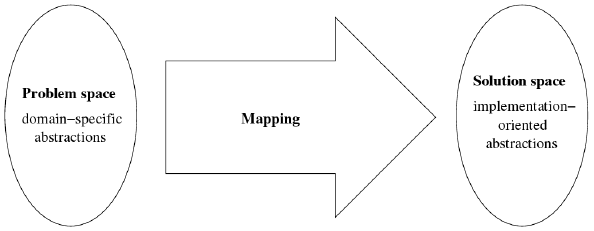
Figure 1: Problem and solution space [47]. From top to bottom, the definitions become less abstract and more technical.
While the first seven definitions reflect that features are abstract concepts of the
target domain, used to specify and distinguish software systems, the last three definitions
capture the fact that features must be implemented in order to satisfy
requirements. This tension between abstract and implementation view is not accidental.
It stems from the different uses of features. For example, in feature modeling,
features are used to describe the variability of a software product line for communication Czarnecki’s and Eisenecker’s distinction between problem space and solution space, as illustrated in Figure 1, is useful for the classification of the definitions presented above [47]. The problem space comprises concepts that describe the requirements on a software system and its intended behavior. The solution space comprises concepts that define how the requirements are satisfied and how the intended behavior is implemented. The first seven definitions describe the feature concept from the perspective of the problem space. Here, features are used to describe what is expected from a software system. The last three definitions describe features from the perspective of the solution space, i.e., how features provide/implement the desired functionality. 2.2 What is Feature-Oriented Software Development?The concept of a feature is useful for the description of commonalities and variabilities in the analysis, design, and implementation of software systems. FOSD is a paradigm that favors the systematic application of the feature concept in all phases of the software life cycle. Features are used as first-class entities to analyze, design, implement, customize, debug, or evolve a software system. That is, features not only emerge from the structure and behavior of a software system, e.g., in the form of the software’s observable behavior, but are also used explicitly and systematically to define variabilities and commonalities, to facilitate reuse, and to structure software along these variabilities and commonalities. A distinguishing property of FOSD is that it aims at a clean (ideally one-to-one) mapping between the representations of features across all phases of the software life cycle. That is, features specified during the analysis phase can be traced through design and implementation. The idea of FOSD was not proposed as such in the first place but emerged from the different uses of features. A main goal of this survey is to convey the idea of FOSD as a general development paradigm. The essence of FOSD can be summarized as follows: on the basis of the feature concept, FOSD facilitates the structure, reuse, and variation of software in a systematic and uniform way. 2.3 Phases of the FOSD ProcessThe FOSD process comprises four phases: (1) domain analysis, (2) domain design and specification, (3) domain implementation, and (4) product configuration and generation. As stated before, a distinguishing property of FOSD is that the feature concept pervades all of these phases. Domain analysis determines which features are part of the software system or software product line. This includes also a domain scoping step that defines the dimension of the domain, i.e., which features are supported and not supported. For example, a company may find it more effective to concentrate on a product line of database systems for automotive systems instead of databases in general. Furthermore, developers gather relevant knowledge about how features relate (e.g., which features require the presence or absence of other features; see Section 4.1). For example, in a database product line, the feature for transaction management is selectable only if the database supports writing access since in a read-only database no transactions are needed [109,108]. In the design and implementation phases, the developers typically create a set of first-class feature artifacts that encapsulate design and implementation information (see Sections 4.2 and 4.3). In our database example there would be a modular design and implementation of a basic database system and modular designs and implementations of features like transaction management, storage management, and query processing. Based on the domain knowledge and the feature artifacts, applications can be generated almost automatically. Due to the clean mapping between features and feature artifacts, the user only needs to specify the desired features by name (see Section 4.4) and, based on the domain knowledge, a generator can pick the corresponding feature artifacts and create an efficient and reliable software product (see Section 4.4). In the database scenario, a generator could, for example, automatically select a B-tree index in favor of a hash map because, in the case of large amounts of data, the B-tree grants faster access. In Figure 2, we illustrate the phases of the FOSD process. For each phase, we show some key technologies, which are explained in the next sections. Rather than explaining them here, the figure is designed to be a reference and signpost for the remaining paper. Note that theory is not a distinct phase (box at the bottom of Figure 2), but provides a foundation for all phases. One may say that the process model is too simplistic for real-world circumstances. This is true, but its purpose is to structure our survey and not to define the development process in a company. 2.4 Why is FOSD Special?There is a substantial overlap of FOSD with other software development paradigms. We explain key differences to some popular alternatives. The idea of stepwise and incremental software development (SISD) is to encapsulate individual development steps that implement distinct design decisions [128, 98, 99, 105]. The result is usually a total (or at least a partial) order of encapsulated development steps (a.k.a. refinements or layers [98, 30]). The goals of this approach are to structure software in order to support change (by removing and adding layers).1 FOSD shares these goals (and has further goals such as reuse and variation). However, many ideas and concepts of FOSD emerged from SISD. In fact, FOSD is the forcefully broadened development of these early ideas in the context of large-scale software synthesis and software product lines. Aspect-oriented software development (AOSD) aims at the modularization of crosscutting concerns. A crosscutting concern is a concern that does not align well with the structure established by object-oriented or functional decomposition [81, 119]. It has been observed that features are frequently crosscutting concerns [116, 91, 18, 74], so the implementation of features can benefit from aspectoriented techniques [96, 18]. While, initially, variation and reuse have not been the main goals of AOSD, there have been considerable efforts in this direction [61,90,87]. We believe that, at some point, both paradigms became difficult to distinguish at the implementation level but FOSD’s aim at simplicity [6, 18], automated software synthesis (see Section 4.4), and algebraic models (see Section 4.5) are still distinguishing characteristics. Component-based software engineering (CBSE) aims at the vision of constructing software systems on demand using off-the-shelf components [65, 118]. Work on service-oriented architectures is a modern instance of this vision [57]. A main difference to FOSD is that components/services are typically black boxes. While this facilitates independent development and deployment, it hinders encapsulating crosscutting features of a software system [100,14]. For example, detaching the code of the transaction management from a database system and encapsulating it in a dedicated component is not possible in practice [74,109]. It has been observed that features are often program slices, i.e., crosscutting concerns [5]. That is, features often do not align well with the decomposition imposed by component models. Using components anyway leads to a non-trivial mapping between features and components [60, 34, 4, 1].
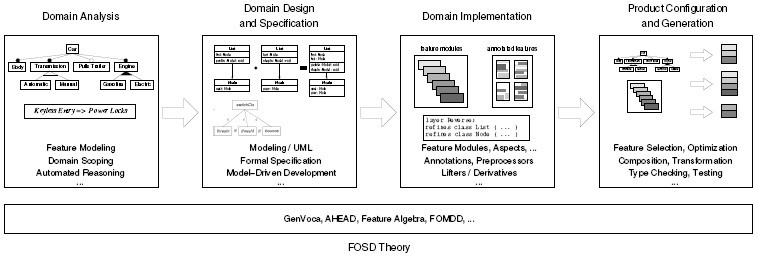
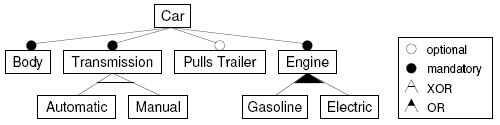
Figure 2: Phases of the FOSD process. The paradigms of software product line and domain engineering aim at families of software systems instead of on a single system and emphasize the similarities between the systems instead of their differences [47,45,101]. FOSD is a development paradigm that can be used to develop product lines and to do domain engineering. However, product line and domain engineering are not limited to FOSD. Especially, the role of features is not central to them. For example, many software product lines are designed with features in mind but implemented without making features explicit. For example, the code base could be implemented with functions, classes, aspects, or components. Concrete products are implemented individually (instead of being generated) and reuse these common artifacts. Usually, there is not clean mapping between features and design and implementation artifacts [47, 34]. The result is that features need to be traced in code [60, 4, 1]. In contrast, FOSD aims at the automated generation of software products. Hence, the programmer does not need to assemble and integrate feature implementations manually, e.g., by writing glue or boilerplate code. 3 THE ROOTS OF FOSDThere are three major lines of research that have contributed to the state of the art of FOSD: feature modeling, feature interaction, and feature implementation. 3.1 Feature ModelingIn their seminal work on feature-oriented domain analysis (FODA), Kang et al. were the first to introduce and use the concept of a feature for the description of the commonalities and variabilities of software systems [70]. Their aim was to structure the problem space (cf. Figure 1). They introduced the notion of a feature model describing the relationships and dependencies of a set of features belonging to a particular domain. In Figure 3, we show a standard example of the feature modeling community in a commonly used feature diagram notation [47]: a feature model that describes the variability of a simple car, i.e., the variants of cars that can be produced in this domain. The root of the tree denotes the concept that is modeled. All other boxes denote features, where child features depend on parent features. There are different types of model elements that describe constraints on the way in which features can be combined, as shown in Figure 3. For example, every car has a body, transmission, and engine (filled circle), but a car does not necessarily have a trailer (empty circle) or the engine may be powered with gasoline or with electricity or with both (filled arc). In contrast to FOSD, the early work on FODA did not make features explicit in design and code, which led to a complex mapping between features and design and implementation artifacts. Nevertheless, feature models have been used successfully in many academic and industrial projects and drive the research and best practice in software product line engineering [70,47,86,121]. They are the de facto standard in modeling variability in product line engineering, and further work on FOSD will build on this success. Since the introduction of feature models, several refinements and extensions have been proposed, some of which we will discuss in Section 4.1.
Figure 3: A feature model of a simple car.
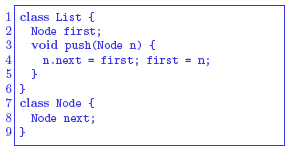
Figure 4: A singly linked list.
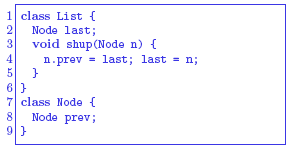
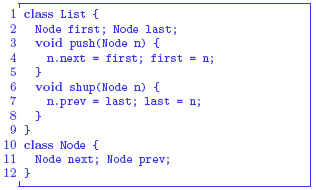
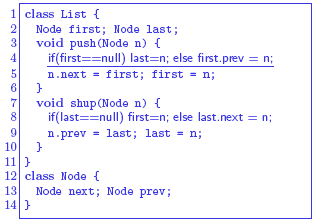
Figure 5: A reversely linked list. 3.2 Feature InteractionIn a different line, researchers and practitioners – mainly from the telecommunications industry – have developed the notion of feature interaction [36, 39]. Although largely developed independently of the work of Kang et al., they use features in a similar sense but with focus on their run time interaction. A feature interaction is a situation in which two or more features exhibit unexpected behavior that does not occur when the features are used in isolation. The standard example is a phone with– beside basic functionality – two features call waiting and call forwarding: when used in isolation, both features work fine, but when used in combination, it is unclear what to do with an incoming call on a busy line. The call is either forwarded or announced; in either case, the expected behavior of one of the two features is compromised. Let us illustrate the problem of feature interaction further by means of a simple code example, which we learned about from Wolfgang Scholz in personal communication. Suppose we have a straightforward implementation of a singly linked list, as shown in Figure 4 (feature Single). Further suppose an implementation of a reversely linked list, as shown in Figure 5, which is also implemented straightforwardly (feature Reverse). Both features, Single and Reverse, work without problems as long as they are isolated. But having both features in a single implementation, henceforth called a doubly linked list, leads to an unexpected behavior. In Figure 6, we show the list implementation including both features.
Figure 6: A doubly linked list with
accidental feature interaction.
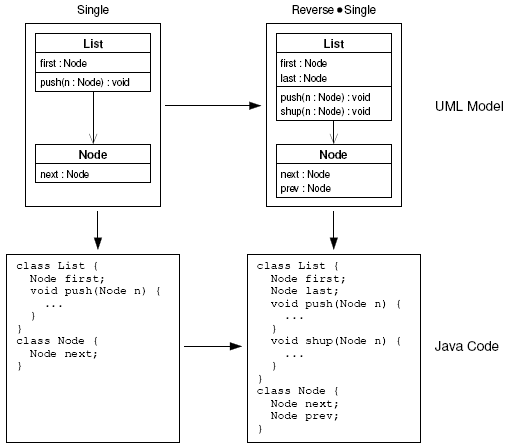
Figure 7: A doubly linked list with resolved feature interaction. In this case, the code of the two features is simply merged (i.e., a structural union); in other examples, the merging is more difficult. Adding an element to the end or in front of the doubly linked list does not preserve the connectivity between the list elements. The reason is that, when adding an element in front of the list with method push, the backward reference prev is not adjusted accordingly and the reference to the last element is not set properly in the case the list is empty – a similar problem occurs in the opposite case. In Figure 7, we show the implementation containing the two features – but now we have fixed the problem by adjusting the references properly. Note that the fixes (underlined) are effective only when both features are present. So the additional code is neither part of feature Single nor of feature Reverse when used in isolation. Feature interaction, as illustrated above, poses a major problem in the development of feature-oriented software systems [36, 39, 89, 88, 82, 79]. There are several techniques for detecting and handling interactions that address this issue (see Section 4.3). 3.3 Feature ImplementationPrehofer was the first who recognized the need for making features (and feature interactions) explicit at the programming language level [104]. He proposed to treat the additional code elements, which a features applies to a base program, as firstclass entities and to separate them from the base code. This allows a developer to trace features easily from the problem space to the solution space, which had been a longstanding problem [60]. The problem of separating the code of different features follows the seminal principle of separation of concerns, credited to Dijkstra [54] and Parnas [98, 99]. Furthermore, Prehofer explored the feature interaction problem at the level of the static program structure. He proposed to factor out code that is necessary to control the interaction of two features in a separate module, called a lifter [104].
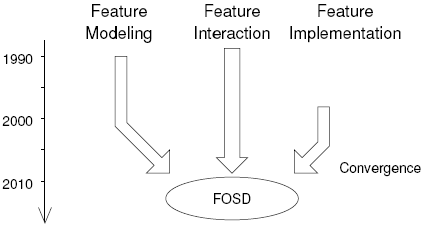
Figure 8: Feature-oriented programming. In our linked list example, a lifter would contain the code for adjusting the references to the next and previous elements (underlined in Figure 7). Technically, Prehofer’s approach builds on the concept of collaboration-based design [106, 126, 116] and mixin techniques [38, 59] to separate feature-related code from the base program. There is a wide variety of work on components and software composition that predates or complements Prehofer’s work and that pursued related ideas, e.g., GenVoca [29], subject-oriented programming [63], aspect-oriented programming [81], adaptive plug-and-play components [95], and role components [126]. All aim at the modularization of software at a greater scale than functions and classes. Although not intended for FOSD, these approaches can be used to implement features cohesively in order to be able to compose them in different combinations, as illustrated in Figure 8. Interestingly, Batory’s work on GenVoca led to several FOSD languages, tools, and theories, which we discuss in the next sections. 3.4 DiscussionAlthough the three roots of FOSD appear different at first glance, they all share the concept of a feature to describe and implement commonalities and variabilities of software systems. Only in recent work the different lines begin to converge toward a unified development methodology, as illustrated in Figure 9. An aim of this survey is to guide and accelerate this process and to strengthen the identity of the FOSD community. In the following sections, we bring together some influential and promising work in the field of FOSD. 4 RECENT DEVELOPMENTS IN FOSDWe structure our discussion of recent work on FOSD along the distinct phases of the FOSD process. We begin with domain analysis and proceed over domain design and implementation toward product configuration and generation. An exception is our discussion of FOSD theory at the end, which “cuts across” all phases of FOSD.
Figure 9: The roots of FOSD and their emerging convergence. 4.1 Domain AnalysisFeature modeling is the central activity in domain analysis. The aim is to identify and capture the variabilities and commonalities of a domain, in the case of FOSD, in the form of a feature model. FODA was the first analysis method that came with its own kind of feature model, as shown in Figure 3. Several analysis methods and processes emerged from FODA, e.g., FORM [71] and FeatureRSEB [62]. These mainly refine and extend the domain analysis process, but features remain the central concept of both approaches. Schobbens et al. compare different kinds of feature models and provide a unifying formal semantics [111]. Recently, on the basis of FODA, several extensions of feature modeling and feature models were proposed. A major line of research aimed at enriching feature models with additional information, e.g., regarding feature cardinalities [48], propositional constraints [24], and non-functional properties of features [113]. The idea is to use this information in the product configuration and generation process in order to rule out invalid or suboptimal product variants (see Section 4.4). Nevertheless, there is a trade-off between expressiveness and simplicity of feature models. The more information is exposed in the model, the more it can guide the configuration and generation process, but the more complex the model becomes. That is, more expressive models are often not “management compatible”, which was their initial strength. In further work, this trade-off should be explored in depth. As feature models became larger, the necessity of automated reasoning became apparent [33, 28]. Mannion [92] and Batory [24] were among the first to note the connection between feature models and propositional formulas. A translation of a feature model into a proposition enables tools to reason about properties of the feature model automatically. For example, tools can answer questions such as: Does a feature selection satisfy constraints imposed by a feature model [24]? How many variants can be generated [32]? Are two feature models identical [122]? Which features and relationships have to be changed to fix an inconsistent feature model [127]? Furthermore, several researchers noted the relationship to grammars and design wizards (i.e., tools that automate the selection of features in order to optimize non-functional properties) and presented approaches to generate, based on feature models, design wizards that present and constrain the configuration options [52, 3, 34, 24, 80]. A subproblem of large feature models is that automated reasoning is time consuming since, in many cases, computing interesting properties is NP-complete (e.g., the satisfiability and equivalence of feature models). Hence, several researchers have explored how to reason about feature models efficiently. For example, binary decision diagrams [94], satisfiability solvers [93], constraint satisfaction solvers [32], or simplified reasoning [122] were used to reason about feature models of up to 10 000 features. In order to guarantee the correctness of analyses and manipulations performed on large-scale feature models, Trinidad et al. propose a framework for the automated error detection [123]. Like any other kind of software artifact, feature models evolve. Hence, programmers need support for refactoring and reverse engineering. The biggest issue is to guarantee that changes to a feature model do not produce errors. Recently, some researchers addressed this issue by providing proper tool support based on efficient reasoning approaches (see above) [51, 50, 122]. To summarize, feature modeling has received much attention by researchers and practitioners in recent years. A trend is to extend and use feature models for automatic product generation, but this complicates the use of features for users who are not domain experts (e.g., managers or customers). While this trend has to be followed in order to realize the full potential of FOSD, it is also important to explore the trade-off between expressiveness and simplicity. 4.2 Domain Design and SpecificationDomain design and specification is the process of defining the architecture of a software product line. In the context of FOSD, this means that the essential structural and behavioral properties of the involved features are specified using a formal or informal specification and/or modeling language. Remarkably, there has not been much work in this direction. FOSD researchers concentrated mainly on feature modeling and feature implementation. That is, once the features and their relationships have been set in a feature model, the features are implemented. This is in stark contrast to non-FOSD approaches, in which developers have to design a product line architecture first in order to define the granularity of components or extension points in a common framework [101]. In FOSD, features structure the design of the software system. Hence, modeling and specification activities do not aim at defining a variable architecture (this is given by the decomposition into features) but at defining the structure and behavior of features and their interactions. Modeling and specification languages have to take features and their potential for combinations and interactions into account. First attempts have been made to specify and model the structure and behavior of a feature in isolation and to ensure the safe composition of features without considering the implementation. Poppelton proposed an approach for feature-oriented specification [102]. He extends Event-B, a widely used formal specification language for safety critical systems, with support for feature composition. The (yet unreached) goal is to propagate proven feature correctness properties through feature composition to the generated software product.
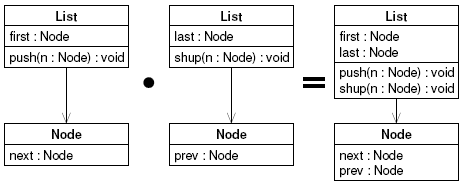
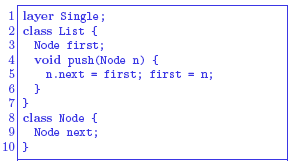
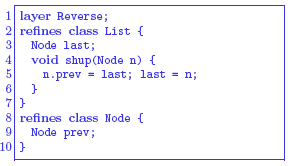
Figure 10: Feature composition involves model merging. Recent work of Trujillo et al. aims at connecting FOSD with model-driven development (MDD) [124]. The key idea is to unify features with MDD transformations. Features are vertical transformations (which elaborate one representation); MDD transformations are horizontal transformations (which map one representation to a different representation). Both are functions, but they are used in different circumstances. Batory et al. proposed a foundation based on category theory to describe the interplay of and constraints on features and MDD transformations [25, 26, 27]. In Batory’s work it is not considered how a feature itself is modeled or specified. Diskin et al. used a similar model to solve some problems in model versioning [55], in which features correspond to updates applied to models. Furthermore, Apel et al. explored how features can be modeled using standard modeling techniques such as the unified modeling language (UML) [8]. The idea is not to model the individual programs that can be derived from a product line but the individual features (e.g., using class, state, and sequence diagrams) and so on, and to merge the models in a prescribed way when a product is generated. Left of the equality in Figure 10, we show the class diagrams of the two features Single and Reverse of our list example (‘•’ denotes feature composition). Right of the equality, we show the merged model that contains the two features and that describes a doubly linked list. The (de)composition of models into features is related to other fields such as aspect-oriented modeling [41, 83, 68, 67]. An alternative approach to represent features in modeling is not to decompose a model along features but to annotate a given model with information on features [46, 64, 112]. This way, we do not have multiple model fragments that correspond to individual features but a single, superimposed model which contains annotations pointing to features. Finally, there is a significant body of work on specifying and resolving feature interactions at the design/specification level [39,107]. The problem is that, especially in distributed systems, the accidental interaction of features becomes only apparent at run time in the form of misbehavior. In order to detect such misbehavior, it is necessary to specify/model the intended behavior. Since the early work on feature interaction, much progress has been made in detecting and resolving feature interactions, for example, using static analysis [69] and model checking [85]. Most of this work aims at networks and distributed systems and is outside the scope of this paper. The connection to other subfields of FOSD, such as feature modeling and implementation, has not been drawn yet. Some work on specification and verification addresses also the feature interaction problem. We discuss this work in Section 4.4 together with other approaches that aim at correct product generation. To summarize, there are many open issues in modeling and specifying features. For example: How can we verify that a composition of features satisfies the specification of the individual features and the desired product? We hope that this survey will encourage more work in this direction. 4.3 Domain ImplementationAs stated before, Prehofer was the first to note the necessity of making features explicit in code [104]. The goal is to establish a one-to-one mapping between features that appear during the domain analysis and features that appear at the implementation level. Prehofer proposed first-class language constructs to represent the changes and additions a feature makes when being added to a program. Since then, much progress has been made in this direction. There are several languages that support the concept of features explicitly. They all share the goal to provide better abstraction and modularization mechanisms for features. For example, Jak is a language that extends Java by feature-oriented mechanisms [30]. Code belonging to a particular feature is stored in a dedicated directory, called a containment hierarchy [30]. Typically, a containment hierarchy contains multiple class and refinement declarations. A refinement declaration is a way to apply the changes a feature makes to a program subsequently, without changing the program’s code. In Figures 11 and 12, we show our list example implemented in Jak. In Figure 11, we have the two classes List and Node of feature Single. These classes are identical to the ones implemented in plain Java (cf. Figure 4), except the layer declaration, which specifies the enclosing feature. In Figure 12, there are the two refinement declarations of feature Reverse that add fields and methods to the classes of feature Single. The result of composing the features Single and Reverse behaves like the code shown in Figure 6. Beside Jak, also feature-oriented language extensions were proposed for C++, called FeatureC++ [17], and for XML, called Xak [2]. Basically, feature-oriented languages rely on programming mechanisms such as mixins [38, 59] and collaborations [106,116,126], but also aspects and subjects became popular in FOSD [61,96, 87, 90, 74, 12, 18]. However, the connection of the original mechanisms to the other phases of the FOSD process is typically not made explicit.
Figure 11: A singly linked list implemented
in Jak.
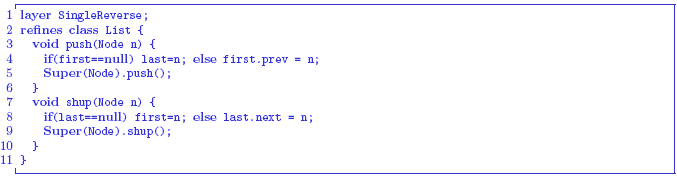
Figure 12: A reversely linked list implemented using refinements. An interesting recent trend is to explore the principles of feature modularity independently of a particular language [30, 91, 7, 15, 37]. The AHEAD tool suite was the first to take advantage of a language-independent model of features (see Section 4.5) and provides support for implementing features in different languages, e.g., Java and grammar specifications [30]. However, the integration of new languages into the AHEAD tools suite was ad hoc and tedious. The FeatureHouse tool suite follows the lead of AHEAD and provides an easy-to-use plug-in mechanism for new languages, based on attribute grammars [15]. This way, many very different languages like C, Haskell, JavaCC, or XHTML could be prepared for implementing and composing features [15, 8, 10]. The work on implementing features has been influenced by the work on feature interactions. Prehofer was the first to note the relevance of feature interactions for implementing features [104]. He observed that, in the presence of feature interactions, the implementation of a feature may vary, as in the example of the doubly linked list (see Section 3.3). Prehofer proposed to separate interaction code from basic feature code in dedicated modules called lifters, i.e., to implement multiple modules per feature, which is a slight departure from the initial goal of work on FOSD (namely, a one-to-many instead of a one-to-one mapping between features and feature artifacts). Liu et al. extended the notion of lifters to derivatives in order to capture higher-order interactions (i.e., interactions between pieces of interaction code) and presented a theory for feature interactions [88] (see Section 4.5). In Figure 13, we show the lifter/derivative SingleReverse that fixes the interaction between the features Single and Reverse by overriding the methods push and shup and adding code for adjusting the references properly (Super(Node) refers to the method that is been refined.). SingleReverse is only present when both Single and Reverse are present. Implementing features in separate feature artifacts (e.g., flavors of modules, containers, or components) is not the only way to make features explicit in the implementation. A view on feature implementation that differs from feature-oriented programming emerged from simple variant and configuration mechanisms like the C preprocessor.
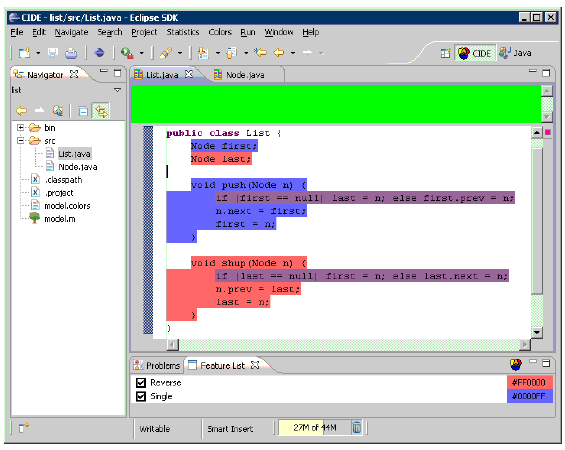
Figure 13: Fixing the interaction between Single and Reverse with a derivative in Jak. The idea is not to implement features using dedicated abstraction and modularization mechanisms, but to annotate code with information on features [72,16], which is basically like annotating models with feature information, as discussed in Section 4.2. For example, in the code base of a database system, one could annotate all code lines with #ifdef-like directives that implement transaction safety. This way, transaction management can be switched on and off at compile time using a single flag. That is, two variants of the database system can be generated, one with and one without transaction management. Additionally, a simple search mechanism can be used to find all code belonging to the transaction feature. Annotation mechanisms such as the C preprocessor are used widely in industry to implement features. An advantage is the fine-grained model of extensions (even statements and expressions can be annotated) [75] and the easy adoption [44]. A disadvantage is that features are not encapsulated in cohesive units but scattered across the code base [72,16]. There seems to be a trade-off between modularity and expressiveness or ease of use that is an interesting open research issue. Commercial product line tools like Gears [84] or pure::variants [34] also support the annotation of code with features. Furthermore, both connect feature models to annotations to achieve a mapping between features in the problem and solution space, but the mapping is usually complex and annotations obfuscate the source code, which results in code that is criticized as “#ifdef hell” [117]. Recently, advances have been made to address these problems [75]. The idea is to provide first-class feature support in an integrated development environment, implemented in a tool called Colored IDE (CIDE), and to separate annotations from code in order not to pollute the code base. Annotations are managed externally and displayed using background colors. A principle of “disciplined” annotations limits annotations to meaningful code fragments [75] and, like in FeatureHouse, CIDE has been designed extensible in order to be able to integrate new languages rapidly [78, 77]. In Figure 14, we show the implementation of the list example using CIDE. Code belonging to the features Single and Reverse has been colored. Interestingly, the problem of varying feature implementations in the presence of feature interactions occurs also in the context of annotation-based approaches [82]. In particular, nested annotations indicate interactions (see Figure 14). The inner-most nest corresponds to a lifter. In CIDE, feature interactions become apparent when colors denoting different feature overlap (the colors are blended in the overlapping region, cf. Figure 7).
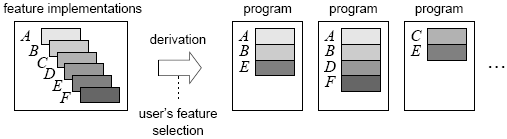
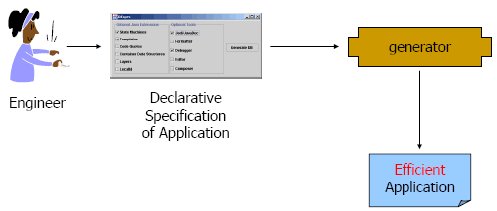
Figure 14: Implementing a doubly linked list in CIDE. To summarize, feature implementation has been receiving much attention in recent years, by programming language designers and tool developers. An open issue is how to combine annotation-based and composition-based approaches in a unified and efficient framework. Furthermore, the idea of factoring feature interaction code via lifters and derivatives is promising, but it is not clear whether this approach scales to a large number of features with many interactions. 4.4 Product Configuration and GenerationIn FOSD, generation plays a key role. The vision is that, following a user’s feature selection, an efficient software system is generated automatically, as illustrated in Figure 15. This differs from the traditional approach of domain and application engineering, in which the user is in charge of assembling, adapting, and integrating the reusable assets produced by domain engineering. Full automation is one of the key goals of FOSD. Several steps are needed to generate an efficient software system from a user’s feature selection. First, to assist the user in selecting a set of desired features, tools need to present the available features as well as their constraints and relationships clearly.
Figure 15: Automatic product generation on the basis of a feature selection [30]. Ideally, invalid feature selections are reported and rejected interactively, i.e., during the feature selection process. Tools like GUIDSL [24], pure::variants [34], FeatureIDE [80], CIDE [76], and many others present available features in the form of interactive feature models (represented as radio buttons and check boxes or trees) and assist users in finding a valid selection by evaluating the relationships in the background, visualizing relationships, and hiding invalid options. The next step is to compute a complete, valid feature selection on the basis
of a partial feature selection by evaluating possible complete feature combinations
and judging their appropriateness. The background is that real-world product lines
have many hundreds or even thousands of features, whose sheer number certainly
overburden the average user. The simplest approach would be to present all feature
selections to the user that are possible. More appropriate would be to use domain
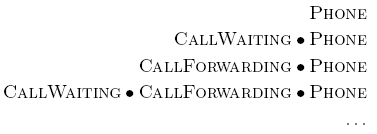
knowledge in order to determine which features work well with other features. In The process of optimizing a feature selection is a form of architectural metaprogramming. Architectural metaprogramming (a.k.a. computational design) is a general approach to software development that provides a unifying view on FOSD, MDD, and refactoring [26, 27]. Architectural metaprogramming can be explained by contrasting it to programming in the small. The basic idea is that programming in the small is creating objects and writing methods that update these objects or that translate objects of one type to another. Programming in the large is where objects represent system designs, and methods are transformations that update these designs or translate designs in one representation to that of another. In this view, a feature selection represents a system design or architecture and optimization is a transformation that updates or changes the design or architecture. Once we have a proper feature selection, the desired software system is generated. Variant generation (a.k.a. product derivation) concerns all kinds of artifacts, from code over models to documentation. As stated in Section 4.3, the work on AHEAD was the first that aimed at an integrated FOSD tool for software artifacts written in different languages. The next generation are tools like FeatureHouse and CIDE, which automate also the integration of new languages to build language-independent composition or generation tools. An important question during generation is whether the generated code is correct.2 There are three levels of correctness: (1) syntactic correctness, i.e., the generated software system is correct with respect to the language’s syntax, (2) type correctness, i.e., the generated software system is well-typed with respect to the language’s type system, and (3) behavioral correctness, i.e., the generated software system behaves correctly according to a formal or informal specification. Furthermore, it is desirable to guarantee correctness properties for the entire product line instead of checking each product variant in isolation. The reason is that generating all systems is not feasible due to the potentially large number of valid feature selections (already for 33 independent, optional features, a variant can be generated for every person on the planet). With regard to syntactic and type correctness of product lines, researchers made considerable progress in recent years [49, 120, 73, 13, 53, 78, 11]. Most prominently, Pietroszek and Czarnecki [49] and Thaker et al. [120] implemented type systems for UML- and AHEAD-based product lines. Also, attempts have been made to formalize type systems for feature-oriented product lines [73, 53, 11]. In contrast, behavioral correctness is difficult to guarantee, due to the lack of feature support of contemporary specification, verification, and validation techniques, but first steps have been made. For example, configuration lifting is a technique that translates feature information into metaprograms and uses established verification techniques to ensure correctness [103]. Classen et al. propose to merge the transition systems representing the behaviors of different features into a single, superimposed transition system and to use information on features and model checking techniques for efficient verification [43]. Alternative approaches, that propose to generate proofs, are promising but have not been considered with regard to software product lines [23]. Another approach of attaining confidence in the generation process is to test or validate a product line [101]. While tests cannot guarantee the absence of errors, they can provide a certain degree of confidence. However, as with type checking, testing all variants of a software product line is in the most cases not feasible. Instead, meaningful subsets [101], model-based and composable tests [97, 125] have to be used. The problem of feature interaction is important in this context since features tested in isolation may obey the desired behavior but their combination may not, as the list example has taught us. It is an open issue whether the entire code base of a product line can be tested instead of generating and testing products individually. To summarize, in recent years techniques and tools from the fields of feature modeling and feature implementation begin to converge toward a unified framework for FOSD. The main challenges are how to specify, verify, and test the correctness of software products generated from product lines, ideally without generating all products. Further important issues are how to represent domain knowledge and how to generate efficient software products based on this information. 4.5 TheoryThe first theory on FOSD, even though at the time it was not called FOSD, was GenVoca. GenVoca models the changes that a feature applies as function application and feature composition as function composition, denoted by •. For example, a product line of telecommunication systems consisting of the three features Phone, CallWaiting, and CallForwarding is modeled as a set: Different variants of telecommunication systems are modeled by composing functions (that represent features) in different combinations: Currently, it is not clear whether the order of features plays or should play a role in modeling product lines. In the case of the list example, the composition order does not matter. In other cases, this may be different [9]. Generally, it has been shown that the order of features depends on the implementation mechanism [15] and that it can be changed by refactorings [22, 82, 9]. But should the user be aware of the order, or should the user just pick the features she needs? AHEAD is the successor of GenVoca. It aims at language independence in that it represent the changes that a feature applies as nested records, in which each element denotes a certain type of artifact. For example, the record below represents feature Single of the list example (including two Java classes and a documentation in HTML):
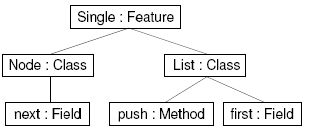
Figure 16: The feature structure tree of feature Single. Another approach is to use specific trees, called feature structure trees [19, 15], as shown in Figure 16. Both approaches (nested records and feature structure trees) share many similarities but also differ in some respects, This is reflected in the fact that two different algebras have been developed [31, 21]. In both algebras, features are represented by algebraic expressions and feature composition is performed by dedicated operations. For example, in the feature algebra of Apel et al. [21, 20], feature Single is represented has follows: Feature Reverse is represented analogously. The composition of the two features
is the addition (using operator The initial idea of using algebra for describing and comparing programming techniques is due to Lopez-Herrejon et al. [91]. A benefit of algebraic models is that they provide insight into the fundamental properties of feature composition, e.g., why feature composition is usually not commutative. Furthermore, algebra has been used to model and reason about feature interactions [89, 88] and product line variability [66]. Finally, in order to realize the vision of architectural metaprogramming, formal models like the feature algebra are essential [26]. Trujillo et al. extended the AHEAD theory toward model-driven development, called feature-oriented model-driven development (FOMDD) [124]. The idea is to integrate software artifacts that reside on different abstraction levels (levels in the model stack) and to model transformations of them uniformly. Beside features, also model refinement involves a transformation. FOMDD reveals their relationship, as illustrated in Figure 17. Still an open issue is how to connect theories at different levels, e.g., at the feature model level [66], the design/modeling level [124], or the implementation level [31,21], into a consistent unified theory that describes all structures and mechanisms used in the FOSD process.
Figure 17: Feature-oriented model-driven development of the list example. 5 PERSPECTIVESince the concept of a feature was first proposed in software engineering, the field of FOSD has been developed forcefully. Researchers from different disciplines have contributed to the current state and success of FOSD. Nevertheless, further steps have to be made in order to realize the full potential of FOSD and to accelerate its adoption in industry and its acceptance in other research fields. We have identified and condensed the following list of key issues, which is ordered following the phases of the FOSD process:
Of course, there are further issues and details that have to be addressed. However, we believe the above list forms an important subset to guide further research. 6 CONCLUSIONThe goal of this article has been to provide an overview of FOSD. Beginning from the roots of FOSD, we have systematically summarized several promising works on FOSD. We hope that our survey will help to reveal connections between different approaches to FOSD, to identify and address open issues, and to guide further work and cooperations between different researchers. The ultimate goal is to establish an identity of the FOSD community and to drive further the convergence of work on FOSD. ACKNOWLEDGMENTSWe thank Don Batory, Krzysztof Czarnecki, Christian Lengauer, Jörg Liebig, Roberto Lopez-Herrejon, Wolfgang Scholz, and Salvador Trujillo for their helpful comments on earlier drafts of this paper. Furthermore, we acknowledge Wolfgang Scholz as inventor of the list example. The first author’s research is sponsored in part by the German Science Foundation (DFG), # AP 206/2-1. Footnotes1 A recent branch of this paradigm is change-oriented software engineering [56]. 2 Note that we could have discussed this issue also in Section 4.3, as it is at the fringe between implementation and generation. REFERENCES[1] N. Aizenbud-Reshef, B. Nolan, J. Rubin, and Y. Shaham-Gafni. Model Traceability. IBM Systems Journal, 45(3):515–526, 2006. [2] F. Anfurrutia, O. D´ıaz, and S. Trujillo. On Refining XML Artifacts. InProceedings of International Conference on Web Engineering (ICWE), volume 4607 of Lecture Notes in Computer Science, pages 473–478. Springer-Verlag, 2007. [3] M. Antkiewicz and K. Czarnecki. FeaturePlugin: Feature Modeling Plug-In for Eclipse. In Proceedings of the OOPSLA Workshop on Eclipse Technology eXchange (ETX), pages 67–72. ACM Press, 2004. [4] G. Antoniol, E. Merlo, Y.-G. Guéhéneuc, and H. Sahraoui. On Feature Traceability in Object Oriented Programs. In Proceedings of the International Workshop on Traceability in Emerging Forms of Software Engineering (TEFSE), pages 73–78. ACM Press, 2005. [5] S. Apel. The Role of Features and Aspects in Software Development. PhD thesis, School of Computer Science, University of Magdeburg, 2007. [6] S. Apel. How AspectJ is Used: An Analysis of Eleven AspectJ Programs. Journal of Object Technology (JOT), 9(1), 2010. [7] S. Apel and D. Hutchins. An Overview of the gDeep Calculus. Technical Report MIP-0712, Department of Informatics and Mathematics, University of Passau, 2007. [8] S. Apel, F. Janda, S. Trujillo, and C. Kästner. Model Superimposition in Software Product Lines. In Proceedings of the International Conference on Model Transformation (ICMT), volume 5563 of Lecture Notes in Computer Science, pages 4–19. Springer-Verlag, 2009. [9] S. Apel, C. Kästner, and D. Batory. Program Refactoring using Functional Aspects. In Proceedings of the International Conference on Generative Programming and Component Engineering (GPCE), pages 161–170. ACM Press, 2008. [10] S. Apel, C. Kästner, A. Größlinger, and C. Lengauer. Feature (De)composition in Functional Programming. In Proceedings of the International Conference on Software Composition (SC), volume 5634 of Lecture Notes in Computer Science, pages 9–26. Springer-Verlag, 2009. [11] S. Apel, C. Kästner, A. Größlinger, and C. Lengauer. Type-Safe Feature-Oriented Product Lines. Technical Report MIP-0909, Department of Informatics and Mathematics, University of Passau, 2009. [12] S. Apel, C. Kästner, T. Leich, and G. Saake. Aspect Refinement - Unifying AOP and Stepwise Refinement. Journal of Object Technology (JOT) – Special Issue: TOOLS EUROPE 2007, 6(9):13–33, 2007. [13] S. Apel, C. Kästner, and C. Lengauer. Feature Featherweight Java: A Calculus for Feature-Oriented Programming and Stepwise Refinement. In Proceedings of the International Conference on Generative Programming and Component Engineering (GPCE), pages 101–112. ACM Press, 2008. [14] S. Apel, C. Kästner, and C. Lengauer. Research Challenges in the Tension Between Features and Services. In Proceedings of the ICSE Workshop on Systems Development in SOA Environments (SDSOA), pages 53–58. ACM Press, 2008. [15] S. Apel, C. Kästner, and C. Lengauer. FeatureHouse: Language-Independent, Automated Software Composition. In Proceedings of the International Conference on Software Engineering (ICSE), pages 221–231. IEEE CS Press, 2009. [16] S. Apel, C. Kästner, and C. Lengauer. Vergleich und Integration von Komposition und Annotation zur Implementierung von Produktlinien. In Software Engineering 2009 – Fachtagung des GI-Fachbereichs Softwaretechnik, volume P-143 of GI-Edition – Lecture Notes in Informatics, pages 101–112. Gesellschaft für Informatik, 2009. [17] S. Apel, T. Leich, M. Rosenmüller, and G. Saake. FeatureC++: On the Symbiosis of Feature-Oriented and Aspect-Oriented Programming. In Proceedings of the International Conference on Generative Programming and Component Engineering (GPCE), volume 3676 of Lecture Notes in Computer Science, pages 125–140. Springer-Verlag, 2005. [18] S. Apel, T. Leich, and G. Saake. Aspectual Feature Modules. IEEE Transactions on Software Engineering (TSE), 34(2):162–180, 2008. [19] S. Apel and C. Lengauer. Superimposition: A Language-Independent Approach to Software Composition. In Proceedings of the International Symposium on Software Composition (SC), volume 4954 of Lecture Notes in Computer Science, pages 20–35. Springer-Verlag, 2008. [20] S. Apel, C. Lengauer, D. Batory, B. Möller, and C. Kästner. An Algebra for Feature-Oriented Software Development. Technical Report MIP-0706, Department of Informatics and Mathematics, University of Passau, 2007. [21] S. Apel, C. Lengauer, B. Möller, and C. Kästner. An Algebra for Features and Feature Composition. In Proceedings of the International Conference on Algebraic Methodology and Software Technology (AMAST), volume 5140 of Lecture Notes in Computer Science, pages 36–50. Springer-Verlag, 2008. [22] S. Apel and J. Liu. On the Notion of Functional Aspects in Aspect-Oriented Refactoring. In Proceedings of the ECOOP Workshop on Aspects, Dependencies, and Interactions (ADI), pages 1–9. Computing Department, Lancaster University, 2006. [23] N. Basir, E. Denney, and B. Fischer. Constructing a Safety Case for Automatically Generated Code from Formal Program Verification Information. In Proceedings of the International Conference on Computer Safety, Reliability, and Security (SAFECOMP), volume 5219 of Lecture Notes in Computer Science, pages 249–262. Springer-Verlag, 2008. [24] D. Batory. Feature Models, Grammars, and Propositional Formulas. In Proceedings of the International Software Product Line Conference (SPLC), volume 3714 of Lecture Notes in Computer Science, pages 7–20. Springer-Verlag, 2005. [25] D. Batory. From Implementation to Theory in Product Synthesis. In Proceedings of the International Symposium on Principles of Programming Languages (POPL), pages 135–136. ACM Press, 2007. [26] D. Batory. Program Refactoring, Program Synthesis, and Model-Driven Development. In Proceedings of the International Conference on Compiler Construction (CC), volume 4420 of Lecture Notes in Computer Science, pages 156–171. Springer-Verlag, 2007. [27] D. Batory, M. Azanza, and J. Saraiva. The Objects and Arrows of Computational Design. In Proceedings of the International Conference on Model Driven Engineering Languages and Systems (MODELS), volume 5301 of Lecture Notes in Computer Science, pages 1–20. Springer-Verlag, 2008. [28] D. Batory, D. Benavides, and A. Ruiz-Cortes. Automated Analysis of Feature Models: Challenges Ahead. Communications of the ACM (CACM), 49(12):45–47, 2006. [29] D. Batory and S. O’Malley. The Design and Implementation of Hierarchical Software Systems with Reusable Components. ACM Transactions on Software Engineering and Methodology (TOSEM), 1(4):355–398, 1992. [30] D. Batory, J. Sarvela, and A. Rauschmayer. Scaling Step-Wise Refinement. IEEE Transactions on Software Engineering (TSE), 30(6):355–371, 2004. [31] D. Batory and D. Smith. Finite Map Spaces and Quarks: Algebras of Program Structure. Technical Report TR-07-66, Department of Computer Science, University of Texas at Austin, 2007. [32] D. Benavides. On the Automated Analysis of Software Product Lines using Feature Models. A Framework for Developing Automated Tool Support. PhD thesis, Department of Computer Languages and Systems, University of Seville, 2007. [33] D. Benavides, P. Trinidad, and A. Ruiz-Cort´es. Automated Reasoning on Feature Models. In Proceedings of the International Conference on Advanced Information Systems Engineering (CAiSE), volume 3520 of Lecture Notes in Computer Science, pages 491–503. Springer-Verlag, 2005. [34] D. Beuche, H. Papajewski, and W. Schr¨oder-Preikschat. Variability Management with Feature Models. Science of Computer Programming (SCP), 53(3):333–352, 2004. [35] J. Bosch. Design and Use of Software Architectures: Adopting and Evolving a Product-Line Approach. ACM Press / Addison-Wesley, 2000. [36] T. Bowen, F. Dworack, C. Chow, N. Griffeth, and G. Herman Y.-J. Lin. The Feature Interaction Problem in Telecommunications Systems. In Proceedings of the International Conference on Software Engineering for Telecommunication Switching Systems (SETSS), pages 59–62. IEEE CS Press, 1989. [37] S. Boxleitner, S. Apel, and C. K¨astner. Language-Independent Quantification and Weaving for Feature Composition. In Proceedings of the International Symposium on Software Composition (SC), volume 5634 of Lecture Notes in Computer Science, pages 45–54. Springer-Verlag, 2009. [38] G. Bracha and W. Cook. Mixin-Based Inheritance. In Proceedings of the International Conference on Object-Oriented Programming, Systems, Languages, and Applications (OOPSLA) and the European Conference on Object-Oriented Programming (ECOOP), pages 303–311. ACM Press, 1990. [39] M. Calder, M. Kolberg, E. Magill, and S. Reiff-Marganiec. Feature Interaction: A Critical Review and Considered Forecast. Computer Networks: The International Journal of Computer and Telecommunications Networking, 41(1):115–141, 2003. [40] K. Chen, W. Zhang, H. Zhao, and H. Mei. An Approach to Constructing Feature Models Based on Requirements Clustering. In Proceedings of the International Conference on Requirements Engineering (RE), pages 31–40. IEEE CS Press, 2005. [41] S. Clarke and E. Baniassad. Aspect-Oriented Analysis and Design. The Theme Approach. Addison-Wesley, 2005. [42] A. Classen, P. Heymans, and P. Schobbens. What’s in a Feature: A Requirements Engineering Perspective. In Proceedings of the International Conference on Fundamental Approaches to Software Engineering (FASE), volume 4961 of Lecture Notes in Computer Science, pages 16–30. Springer-Verlag, 2008. [43] A. Classen, P. Heymans, T. Tun, and B. Nuseibeh. Towards Safer Composition. In Companion Volume of the International Conference on Software Engineering (ICSE), pages 227–230. IEEE CS Press, 2009. [44] P. Clements and C. Krueger. Point/Counterpoint. IEEE Software, 19(4):28–31, 2002. [45] P. Clements and L. Northrop. Software Product Lines: Practices and Patterns. Addison-Wesley, 2002. [46] K. Czarnecki and M. Antkiewicz. Mapping Features to Models: A Template Approach Based on Superimposed Variants. In Proceedings of the International Conference on Generative Programming and Component Engineering (GPCE), volume 3676 of Lecture Notes in Computer Science, pages 422–437. Springer-Verlag, 2005. [47] K. Czarnecki and U. Eisenecker. Generative Programming: Methods, Tools, and Applications. Addison-Wesley, 2000. [48] K. Czarnecki, S. Helsen, and U. Eisenecker. Formalizing Cardinality-Based Feature Models and their Specialization. Software Process: Improvement and Practice, 10(1):7–29, 2005. [49] K. Czarnecki and K. Pietroszek. Verifying Feature-Based Model Templates Against Well-Formedness OCL Constraints. In Proceedings of the International Conference on Generative Programming and Component Engineering (GPCE), pages 211–220. ACM Press, 2006. [50] K. Czarnecki, S. She, and A. Wasowski. Sample Spaces and Feature Models: There and Back Again. In Proceedings of the International Software Product Line Conference (SPLC), pages 22–31. IEEE CS Press, 2008. [51] K. Czarnecki and A.Wasowski. Feature Diagrams and Logics: There and Back Again. In Proceedings of the International Software Product Line Conference (SPLC), pages 23–34. IEEE CS Press, 2007. [52] M. de Jonge and J. Visser. Grammars as Feature Diagrams. In Proceedings of the ICSR Workshop on Generative Programming (GP), pages 23–24. Department of Computer Science, University of Texas at Austin, 2002. [53] B. Delaware, W. Cook, and D. Batory. A Machine-Checked Model of Safe Composition. In Proceedings of the International Workshop on Foundations of Aspect-Oriented Languages (FOAL), pages 31–35. ACM Press, 2009. [54] E. Dijkstra. A Discipline of Programming. Prentice Hall, 1976. [55] Z. Diskin, M. Antkiewicz, and K. Czarnecki. Model Versioning-in-the-large: Algebraic Foundations and the Tile Notation. In Proceedings of the International Workshop on Comparison and Versioning of Software Models (CVSM). IEEE CS Press, 2009. [56] P. Ebraert, J. Vallejos, P. Costanza, E. Van Paesschen, and T. D’Hondt. Change-Oriented Software Engineering. In Proceedings of the International Conference on Dynamic languages (ICDL), pages 3–24. ACM Press, 2007. [57] T. Erl. Service-Orieted Architecture: Concepts, Technology, and Design. Prentice Hall, 2005. [58] R. Filman, T. Elrad, S. Clarke, and M. Aksit, editors. Aspect-Oriented Software Development. Addison-Wesley, 2005. [59] M. Flatt, S. Krishnamurthi, and M. Felleisen. Classes and Mixins. In Proceedings of the International Symposium on Principles of Programming Languages (POPL), pages 171–183. ACM Press, 1998. [60] O. Gotel and A. Finkelstein. An Analysis of the Requirements Traceability Problem. In Proceedings of the International Conference on Requirements Engineering (ICRE), pages 94–101. IEEE CS Press, 1994. [61] M. Griss. Implementing Product Line Features by Composing Aspects. In Proceedings of the International Software Product Line Conference (SPLC), pages 271–288. Kluwer Academic Publishers, 2000. [62] M. Griss, J. Favaro, and M. d’Alessandro. Integrating Feature Modeling with the RSEB. In Proceedings of the International Conference on Software Reuse (ICSR), pages 76–85. IEEE CS Press, 1998. [63] W. Harrison and H. Ossher. Subject-Oriented Programming: A Critique of Pure Objects. In Proceedings of the International Conference on Object-Oriented Programming, Systems, Languages, and Applications (OOPSLA), pages 411–428. ACM Press, 1993. [64] F. Heidenreich, J. Kopcsek, and C.Wende. FeatureMapper: Mapping Features to Models. In Companion Proceedings of the International Conference on Software Engineering (ICSE), pages 943–944. ACM Press, 2008. [65] G. Heineman and W. Councill. Component-Based Software Engineering: Putting the Pieces Together. Addison-Wesley, 2001. [66] P. Höfner, R. Khedri, and B. Möller. Feature Algebra. In Proceedings of the , volume 4085 of Lecture Notes in Computer Science, pages 300–315. Springer-Verlag, 2006. [67] J.-M. Jezequel. Model Driven Design and Aspect Weaving. Software and Systems Modeling (SoSyM), 7(2):209–218, 2008. [68] A. Jossic, M. Del Fabro, J.-P. Lerat, J. Bezivin, and F. Jouault. Model Integration with Model Weaving: A Case Study in System Architecture. In Proceedings of the International Conference on Systems Engineering and Modeling (ICSEM), pages 79–84. IEEE CS Press, 2007. [69] H. Jouve, P. Le Gall, and S. Coudert. An Automatic Off-line Feature Interaction Detection Method by Static Analysis of Specifications. In Proceedings of the International Conference on Feature Interactions in Software and Communication Systems (ICFI), pages 131–146. IOS Press, 2005. [70] K. Kang, S. Cohen, J. Hess, W. Novak, and A. Peterson. Feature-Oriented Domain Analysis (FODA) Feasibility Study. Technical Report CMU/SEI-90-TR-21, Software Engineering Institute, Carnegie Mellon University, 1990. [71] K. Kang, S. Kim, J. Lee, K. Kim, G. Kim, and E. Shin. FORM: A Feature-Oriented ReuseMethod with Domain-Specific Reference Architectures. Annals of Software Engineering, 5(1):143–168, 1998. [72] C. Kästner and S. Apel. Integrating Compositional and Annotative Approaches for Product Line Engineering. In Proceedings of the Workshop on Modularization, Composition, and Generative Techniques for Product Line Engineering (McGPLE), pages 35–40. University of Passau, 2008. [73] C. Kästner and S. Apel. Type-Checking Software Product Lines – A Formal Approach. In Proceedings of the International Conference on Automated Software Engineering (ASE), pages 258–267. IEEE CS Press, 2008. [74] C. Kästner, S. Apel, and D. Batory. A Case Study Implementing Features using AspectJ. In Proceedings of the International Software Product Line Conference (SPLC), pages 223–232. IEEE CS Press, 2007. [75] C. Kästner, S. Apel, and M. Kuhlemann. Granularity in Software Product Lines. In Proceedings of the International Conference on Software Engineering (ICSE), pages 311–320. ACM Press, 2008. [76] C. Kästner, S. Apel, and S. Trujillo. Visualizing Software Product Line Variabilities in Source Code. In Proceedings of the SPLC Workshop on Visualization in Software Product Line Engineering (ViSPLE), pages 303–313. Lero, University of Limerick, 2008. [77] C. Kästner, S. Apel, S. Trujillo, M. Kuhlemann, and D. Batory. Language-Independent Safe Decomposition of Legacy Applications into Features. Technical Report 02/2008, School of Computer Science, University of Magdeburg, 2008. [78] C. Kästner, S. Apel, S. Trujillo, M. Kuhlemann, and D. Batory. Guaranteeing Syntactic Correctness for all Product Line Variants: A Language-Independent Approach. In Proceedings of the International Conference on Objects, Models, Components, Patterns (TOOLS EUROPE), volume 33 of Lecture Notes in Business and Information Processing, pages 175–194. Springer-Verlag, 2009. [79] C. Kästner, S. Apel, S. ur Rahman, M. Rosenm¨uller, D. Batory, and G. Saake. On the Impact of the Optional Feature Problem: Analysis and Case Studies. In Proceedings of the International Software Product Line Conference (SPLC). Software Engineering Institute, Carnegie Mellon University, 2009. [80] C. Kästner, T. Th¨um, G. Saake, J. Feigenspan, T. Leich, F. Wielgorz, and S. Apel. FeatureIDE: Tool Framework for Feature-Oriented Software Development. In Proceedings of the International Conference on Software Engineering (ICSE), pages 611–614. IEEE CS Press, 2009. [81] G. Kiczales, J. Lamping, A. Mendhekar, C. Maeda, C. Lopes, J.-M. Loingtier, and J. Irwin. Aspect-Oriented Programming. In Proceedings of the European Conference on Object-Oriented Programming (ECOOP), volume 1241 of Lecture Notes in Computer Science, pages 220–242. Springer-Verlag, 1997. [82] C. Kim, C. Kästner, and D. Batory. On the Modularity of Feature Interactions. In Proceedings of the International Conference on Generative Programming and Component Engineering (GPCE), pages 23–34. ACM Press, 2008. [83] D. Kolovos, R. Paige, and F. Polack. Merging Models with the Epsilon Merging Language (EML). In Proceedings of the International Conference on Model Driven Engineering Languages and Systems (MODELS), volume 4199 of Lecture Notes in Computer Science, pages 215–229. Springer-Verlag, 2006. [84] C. Krueger. The BigLever Software Gears Unified Software Product Line Engineering Framework. In Proceedings of the International Software Product Line Conference (SPLC), pages 353–353. IEEE CS Press, 2008. [85] A. Layouni, L. Logrippo, and K. Turner. Conflict Detection in Call Control Using First-Order Logic Model Checking. In Proceedings of the International Conference on Feature Interactions in Software and Communication Systems (ICFI), pages 66–82. IOS Press, 2007. [86] J. Lee and D. Muthig. Feature-Oriented Variability Management in Product Line Engineering. Communications of the ACM (CACM), 49(12):55–59, 2006. [87] K. Lee, K. Kang, M. Kim, and S. Park. Combining Feature-Oriented Analysis and Aspect-Oriented Programming for Product Line Asset Development. In Proceedings of the International Software Product Line Conference (SPLC), pages 103–112. IEEE CS Press, 2006. [88] J. Liu, D. Batory, and C. Lengauer. Feature-Oriented Refactoring of Legacy Applications. In Proceedings of the International Conference on Software Engineering (ICSE), pages 112–121. ACM Press, 2006. [89] J. Liu, D. Batory, and S. Nedunuri. Modeling Interactions in Feature-Oriented Designs. In Proceedings of the International Conference on Feature Interactions in Software and Communication Systems (ICFI), pages 178–197. IOS Press, 2005. [90] D. Lohmann, O. Spinczyk, and W. Schröder-Preikschat. Lean and Efficient System Software Product Lines: Where Aspects Beat Objects. Transactions on Aspect-Oriented Software Development (TAOSD), 2(1):227–255, 2006. [91] R. Lopez-Herrejon, D. Batory, and W. Cook. Evaluating Support for Features in Advanced Modularization Technologies. In Proceedings of the European Conference on Object-Oriented Programming (ECOOP), volume 3586 of Lecture Notes in Computer Science, pages 169–194. Springer-Verlag, 2005. [92] M. Mannion. Using First-Order Logic for Product Line Model Validation. In Proceedings of the International Software Product Line Conference (SPLC), volume 2379 of Lecture Notes in Computer Science, pages 176–187. Springer-Verlag, 2002. [93] M. Mendonca, A. Wasowski, and K. Czarnecki. SAT-based Analysis of Feature Models is Easy. In Proceedings of the International Software Product Line Conference (SPLC). Software Engineering Institute, Carnegie Mellon University, 2009. [94] M. Mendonca, A. Wasowski, K. Czarnecki, and D. Cowan. Efficient Compilation Techniques for Large Scale Feature Models. In Proceedings of the International Conference on Generative Programming and Component Engineering (GPCE), pages 13–22. ACM Press, 2008. [95] M. Mezini and K. Lieberherr. Adaptive Plug-and-Play Components for Evolutionary Software Development. In Proceedings of the International Conference on Object-Oriented Programming, Systems, Languages, and Applications (OOPSLA), pages 97–116. ACM Press, 1998. [96] M. Mezini and K. Ostermann. Variability Management with Feature-Oriented Programming and Aspects. In Proceedings of the International Symposium on Foundations of Software Engineering (FSE), pages 127–136. ACM Press, 2004. [97] E. Olimpiew and H. Gomaa. Model-Based Testing for Applications Derived from Software Product Lines. SIGSOFT Software Engineering Notes, 30(4):1– 7, 2005. [98] D. Parnas. On the Design and Development of Program Families. IEEE Transactions on Software Engineering (TSE), SE-2(1):1–9, 1976. [99] D. Parnas. Designing Software for Ease of Extension and Contraction. IEEE Transactions on Software Engineering (TSE), SE-5(2):264–277, 1979. [100] R. Pichler, K. Ostermann, and M. Mezini. On Aspectualizing Component Models. Software Practice and Experience (SPE), 33(10):957–974, 2003. [101] K. Pohl, G. Böckle, and F. van der Linden. Software Product Line Engineering. Foundations, Principles, and Techniques. Springer-Verlag, 2005. [102] M. Poppleton. Towards Feature-Oriented Specification and Development with Event-B. In Proceedings of the International Working Conference on Requirements Engineering: Foundation for Software Quality (REFSQ), volume 4542 of Lecture Notes in Computer Science, pages 367–381. Springer-Verlag, 2007. [103] H. Post and C. Sinz. Configuration Lifting: Verification meets Software Configuration. In Proceedings of the International Conference on Automated Software Engineering (ASE), pages 347–350. IEEE CS Press, 2008. [104] C. Prehofer. Feature-Oriented Programming: A Fresh Look at Objects. In Proceedings of the European Conference on Object-Oriented Programming (ECOOP), volume 1241 of Lecture Notes in Computer Science, pages 419–443. Springer-Verlag, 1997. [105] V. Rajlich. Changing the Paradigm of Software Engineering. Communications of the ACM (CACM), 49(8):67–70, 2006. [106] T. Reenskaug, E. Andersen, A. Berre, A. Hurlen, A. Landmark, O. Lehne, E. Nordhagen, E. Ness-Ulseth, G. Oftedal, A. Skaar, and P. Stenslet. OORASS: Seamless Support for the Creation and Maintenance of Object-Oriented Systems. Journal of Object-Oriented Programming (JOOP), 5(6):27–41, 1992. [107] S. Reiff-Marganiec and M. Ryan, editors. Proceedings of the International Conference on Feature Interactions in Software and Communication Systems (ICFI). IOS Press, 2005. [108] M. Rosenmüller, C. Kästner, N. Siegmund, S. Sunkle, S. Apel, T. Leich, and G. Saake. SQL ´a la Carte – Toward Tailor-made Data Management. In Datenbanksysteme in Business, Technologie und Web – Fachtagung des GI-Fachbereichs Datenbanken und Informationssysteme, volume P-144 of GI-Edition– Lecture Notes in Informatics, pages 117–136. Gesellschaft f¨ur Informatik, 2009. [109] M. Rosenmüller, N. Siegmund, H. Schirmeier, J. Sincero, S. Apel, T. Leich, O. Spinczyk, and G. Saake. FAME-DBMS: Talor-made Data Management Solutions for Embedded Systems. In Proceedings of EDBT Workshop on Software Engineering for Tailor-made Data Management (SETMDM), pages 1–6. ACM Press, 2008. [110] H. Schirmeier and O. Spinczyk. Tailoring Infrastructure Software Product Lines by Static Application Analysis. In Proceedings of the International Software Product Line Conference (SPLC), pages 255–260. IEEE CS Press, 2007. [111] P.-Y. Schobbens, P. Heymans, and J.-C. Trigaux. Feature Diagrams: A Survey and a Formal Semantics. In Proceedings of the International Requirements Engineering Conference (RE), pages 136–145. IEEE CS Press, 2006. [112] N. Siegmund, C. Kästner, M. Rosenmüller, F. Heidenreich, S. Apel, and G. Saake. Bridging the Gap between Variability in Client Application and Database Schema. In Datenbanksysteme in Business, Technologie und Web – Fachtagung des GI-Fachbereichs Datenbanken und Informationssysteme, volume P-144 of GI-Edition – Lecture Notes in Informatics, pages 297–306. Gesellschaft f¨ur Informatik, 2009. [113] N. Siegmund, M. Kuhlemann, M. Rosenmüller, C. Kästner, and G. Saake. Integrated Product Line Model for Semi-Automated Product Derivation Using Non-Functional Properties. In Proceedings of the Workshop on Variability Modelling of Software-intensive Systems (VaMoS), ICB Research Report, pages 25–31. University of Duisburg-Essen, 2008. [114] N. Siegmund, M. Rosenmüller, M. Kuhlemann, C. Kästner, and G. Saake. Measuring Non-functional Properties in Software Product Lines for Product Derivation. In Proceedings of the International Asia-Pacific Software Engineering Conference (APSEC), pages 187–194. IEEE CS Press, 2008. [115] J. Sincero, O. Spinczyk, and W. Schröder-Preikschat. On the Configuration of Non-Functional Properties in Software Product Lines. In Proceedings of the International Software Product Line Conference (SPLC) – Second Volume (Workshops), pages 167–173. IEEE CS Press, 2007. [116] Y. Smaragdakis and D. Batory. Mixin Layers: An Object-Oriented Implementation Technique for Refinements and Collaboration-Based Designs. ACM Transactions on Software Engineering and Methodology (TOSEM), 11(2):215–255, 2002. [117] H. Spencer and G. Collyer. #ifdef Considered Harmful, or Portability Experience With C News. In Proceedings of the USENIX Summer 1992 Technical Conference, pages 185–197. USENIX Association, 1992. [118] C. Szyperski, D. Gruntz, and S. Murer. Component Software – Beyond Object-Oriented Programming. ACM Press / Addison-Wesley, 2nd edition, 2002. [119] P. Tarr, H. Ossher, W. Harrison, and S. Sutton, Jr. N Degrees of Separation: Multi-Dimensional Separation of Concerns. In Proceedings of the International Conference on Software Engineering (ICSE), pages 107–119. IEEE CS Press, 1999. [120] S. Thaker, D. Batory, D. Kitchin, and W. Cook. Safe Composition of Product Lines. In Proceedings of the International Conference on Generative Programming and Component Engineering (GPCE), pages 95–104. ACM Press, 2007. [121] S. Thiel and K. Pohl, editors. Proceedings of the International Software Product Line Conference (SPLC). Lero, University of Limerick, 2008. [122] T. Thüm, D. Batory, and C. Kästner. Reasoning about Edits to Feature Models. In Proceedings of the International Conference on Software Engineering (ICSE), pages 254–264. IEEE CS Press, 2009. [123] P. Trinidad, D. Benavides, A. Duran, A. Ruiz-Cortes, and M. Toro. Automated Error Analysis for the Agilization of Feature Modeling. Journal of Systems and Software (JSS), 81(6):883–896, 2008. [124] S. Trujillo, D. Batory, and O. Dìaz. Feature Oriented Model Driven Development: A Case Study for Portlets. In Proceedings of the International Conference on Software Engineering (ICSE), pages 44–53. IEEE CS Press, 2007. [125] E. Uzuncaova, D. Garcia, S. Khurshid, and D. Batory. Testing Software Product Lines Using Incremental Test Generation. In Proceedings of the International Symposium on Software Reliability Engineering (ISSRE), pages 249–258. IEEE CS Press, 2008. [126] M. VanHilst and D. Notkin. Using Role Components in Implement Collaboration-based Designs. In Proceedings of the International Conference on Object-Oriented Programming, Systems, Languages, and Applications (OOPSLA), pages 359–369. ACM Press, 1996. [127] J. White, D. Schmidt, D. Benavides, P. Trinidad, and A. Ruiz-Cortes. Automated Diagnosis of Product-line Configuration Errors in Feature Models. In Proceedings of the International Software Product Line Conference (SPLC), pages 225–234. IEEE CS Press, 2008. [128] N. Wirth. Program Development by Stepwise Refinement. Communications of the ACM (CACM), 14(4):221–227, 1971. [129] P. Zave. An Experiment in Feature Engineering. In Programming Methodology, pages 353–377. Springer-Verlag, 2003. About the author
|
|||||||||||||





 ) of the summands of the two features’ algebraic
expressions.
) of the summands of the two features’ algebraic
expressions.