AbstractContext-dependent behavior is becoming increasingly important for a wide range of application domains, from pervasive computing to common business applications. Unfortunately, mainstream programming languages do not provide mechanisms that enable software entities to adapt their behavior dynamically to the current execution context. This leads developers to adopt convoluted designs to achieve the necessary runtime flexibility. We propose a new programming technique called Context-oriented Programming (COP) which addresses this problem. COP treats context explicitly, and provides mechanisms to dynamically adapt behavior in reaction to changes in context, even after system deployment at runtime. In this paper we lay the foundations of COP, show how dynamic layer activation enables multi-dimensional dispatch, illustrate the application of COP by examples in several language extensions, and demonstrate that COP is largely independent of other commitments to programming style. 1 INTRODUCTIONContextual information is playing an increasingly important role for applications and services ranging from those that are location-based to those that are situationdependent or even deeply personalized. While context-awareness is already an integral part of regular business applications, it is becoming even more critical for mobile and ubiquitous computing, where devices must adapt their behavior to the services available in their current environment. Despite the fact that context is clearly a central notion to an emerging class of applications, there is little explicit support for context awareness in mainstream programming languages and runtime environments. This makes the development of these applications more complex than necessary. In this paper we argue the need for a new programming approach, called Context-oriented Programming (COP), which treats context explicitly and makes it accessible and manipulable by software. One difficulty in proposing a concrete COP language is that context covers a wide range of concepts ranging from domain-specific to technology-dependent attributes, and including properties that may be spatial or temporal, or even based in hardware or software. We see personalization, sharing, location-awareness, ubiquitous computing, software evolution, runtime adaptation, and xecution context dependencies as a part of COP’s application domain. At present, the lack of programming mechanisms to support the development of context-aware applications forces the design of these applications to be more complex and fragile than need be the case. This paper presents Context-oriented Programming (COP) as a new programming technique to enable context-dependent computation. We claim that Contextoriented Programming brings a similar degree of dynamicity to the notion of behavioral variations that object-oriented programming brought to ad-hoc polymorphism. In support of this claim, we argue that the dynamic representation of layers and their scoped activation and deactivation in arbitrary places of the code are the essential ingredients for COP. Notably, in this paper we discuss:
style to integrate crosscutting concerns. 2 PROBLEMSA context-dependent application varies its behavior according to conditions arising during execution. In order to pin down the term context, we offer the following abstract picture of context-dependence (see Figures 1a, b, and c). An actor (as in UML) is an entity that interacts with the system, calling functions, sending messages, or employing other means of interaction in order to request the desired system behavior. A system is a computational entity that provides some desired behavior whenever requested. A system may be large or small, finely-grained or coarsely-grained. The constituents of a system may, for example, be procedures, methods, objects, components or subsystems. An environment represents anything external to the relationship and interaction between actor and system.
Figure 1: Actor-, environment, and system-dependent behavior variations. The actors, the system, and the environment each contribute to the context that may influence the behavior of the application. Actor-dependent, system-dependent, and environment-dependent variations are described independently and separately, but can occur in any combination. Note that actor, system, and environment represent distinct roles that depend on a particular point of view at a specific point in time and can in principle be filled by all involved entities interchangeably. A piece of software may play the role of the system in one interaction, the actor in another, and provide the environmental context for yet a third. Examples of actors and systems are senders and receivers of messages in object systems, or clients and servers of remote procedures in distributed environments. Actor-dependent Behavior VariationsAn example of actor-dependent behavior variation is that of multiple visualizations of the same system or system entity, such as the rendering of statistical data as in different kinds of charts. Here, an actor determines which information provided by or obtainable from the system will be shown and in what form, contributing to the context-dependent behavior of the system. A system needs to behave differently not only in response to different requests, but often also in response to the same request by different actors (Figure 1a). Environment-dependent Behavior VariationsAn environment-dependent behavior variation is essentially any conditional guarding a subset of application behavior or execution. Examples are anything that is not given implicitly by the flow of control in the execution of a piece of code but needs to be checked explicitly, such as the object a variable is referring to, the time of day, the battery status of the current device, or the temperature read out of sensory equipment. Often, related code is scattered over several system parts to coordinate activation or blocking of related environment-dependent behavior variations. A system’s response to a stimulus initiated by an actor may need to be adjusted to take into account properties of the computational environment. Here, the system’s behavior can be affected by anything adjunct to the immediate interaction between actor and system (Figure 1b). System-dependent Behavior VariationsAn example of system-dependent behavior variation is that of change notification, the dissemination of information about what system parts have changed, and how. The way change notifications can be observed should depend on the relationships between the various system parts involved or affected. Often, multiple and redundant notifications are generated for a single change, resulting in cascading updates or other undesirable effects. A system may need to vary its behavior depending on its own current state, historical information, or dependencies to other system parts or subsystems. In such case the context that influences behavioral variation is not determined by different actors, but by the system itself (Figure 1c). 3 CONTEXT-ORIENTED PROGRAMMINGContext-oriented Programming enables the expression of behavioral variation dependent on context. To analyze and distill what constructs are necessary to enable expressing context-dependent behavioral variations, we have carried out a number of application and language extension experiments. Among others, we have implemented exception handling [2], multiple views on the same object which are selected based on execution context [14], coordination of screen updates [16], discerning of phone calls based on the context of both callers and callees [41], selecting billing schemes based on dynamic context conditions [15], and traversals of expression trees [26]. ContextL, our first language extension that explicitly supports our vision of Context-oriented Programming, has already been integrated into Lisp on Lines, a Web framework that is used in commercial applications [12], and is used for generating different document formats (like html, pdf, etc.) from the same object structures. In other settings, we have developed Piccola, a language with first-class namespaces [1], a context-oriented extension of AspectS [25] for Smalltalk/Squeak, ContextS for Smalltalk/Squeak, and context-oriented extensions of AmbientTalk [42]. Based on these implementations of both application scenarios and necessary language extensions, we identify the following essential language properties to support COP: (a) means to specify behavioral variations, (b) means to group variations into layers, (c) dynamic activation and deactivation of layers based on context, and (d) means to explicitly and dynamically control the scope of layers. Based on our fi ndings, approaches to COP should at least address the following properties: Based on these implementations of both application scenarios and necessary language extensions, we identify the following essential language properties to support COP: (a) a means to specify behavioral variations, (b) a means to group variations into layers, (c) dynamic activation and deactivation of layers based on context, and (d) means to explicitly and dynamically control the scope of layers. Based on our findings, approaches to COP should at least address the following properties:
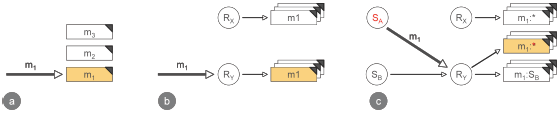
Layers are composed in reaction to contextual information. Based on information available in the current execution context, specific layers may be activated or deactivated. COP languages and environment extensions provide the mechanisms for expressing, activating and composing layers at runtime, but it is the application domain that determines which contextual information is relevant. This last part may be counter-intuitive, but based on our experience, it is indeed not necessary to provide explicit support for context modeling, since existing object-oriented abstraction mechanisms are sufficient to model context [17]. 4 MULTI-DIMENSIONAL MESSAGE DISPATCHFollowing Smith and Ungar [37], we present COP in the context of multi-dimensional message dispatch. While this is not to suggest that COP implementations have to be based on such concepts, we believe that this analogy will help the reader to understand that COP is a continuation of other work, namely procedural, objectoriented, and subjective programming. One-dimensional dispatch. Procedural programming provides only one dimension to associate a computational unit with a name [37]. Here, procedure calls or names are directly mapped to procedure implementations. In Figure 2a calling m1 leaves no choice but the invocation of the only implementation of procedure m1. Two-dimensional dispatch. Object-oriented programming adds another dimension for name resolution to that of procedural programming [37]. In addition to the method or procedure name, message dispatch takes the message receiver into consideration when looking up a method. In Figure 2b we see two implementations of method m1. The selection of the appropriate method not only depends on the the message name m1, but also the receiver of the actual message, here Ry. Three-dimensional dispatch. Subjective programming as introduced by Smith and Ungar [37] extends object-oriented method dispatch by yet another dimension.
Figure 2: One-, two-, and three-dimensional method dispatch.
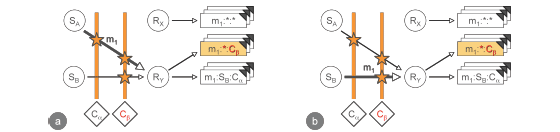
Figure 3: Four-dimensional method dispatch. Here, methods are not only selected based on the name of a message and its receiver but also on its sender. In Figure 2c sender SA sends message m1 to receiver Ry. Ry implements two methods m1: The first one is associated with any sender (m1:*), but the second one only with sender SB (m1:SB). This is why, in our example, m1:* is selected for execution. Four-dimensional dispatch. Context-oriented Programming takes subjective programming one step further by dispatching not only on the name of a message, its sender and its receiver, but also on the context of the actual message send. Context, as stated in Section 3, is anything that is computationally accessible, either directly or derived. Based on context information, methods or their partial definitions are selected for or excluded from message dispatch, leading to context-dependent behavioral variations as described in the previous sections. In Figure 3 there are two scenarios showing how context can affect method dispatch in COP environments. In both scenarios a message m1 is sent to the same receiver Ry, from different senders (SA and SB), and in different contexts (Cα and Cβ). In Figure 3a, our selection process results in method m1:*:Cβ. This is because that particular partial method implementation matches with messages m1, sent to receivers Ry , by any sender (* is matched by sender SA), in both contexts Cα or Cβ. In Figure 3b, our selection process results also in method m1:*:Cβ, now because the message and its sender and receiver correspond to the method’s properties as before, and in addition to that context Cβ matches with m1’s Cβ property as well. Method m1:*:Cα will not match with our request due to incompatible context properties. Please note that combinations of context-conditions can be considered in method dispatch but are not discussed in this paper.
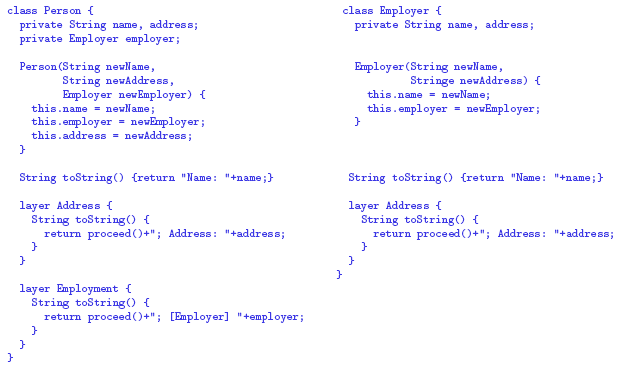
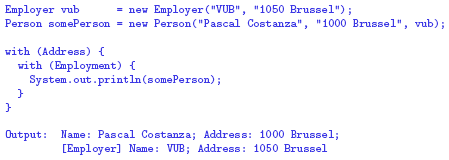
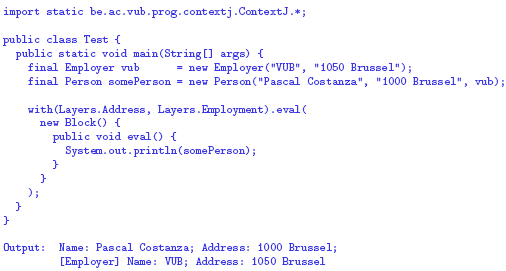
Figure 4: Layers providing different display behavior. 5 EXAMPLESIn this section, we come back to the problems described in Section 2 and use them to both describe COP-based example solutions as well as language extensions. We first discuss actor-dependent behavior variations using ContextJ for Java to implement multiple views on objects. Then, we show how to conditionally activate and deactivate behavioral variations based on explicitly checking properties that are not directly associated with the current flow of control using ContextS for Squeak/Smalltalk. Finally, we illustrate system-dependent behavior variations based on an implementation of change notifications in ContextL for Lisp. In addition to illustrating how COP can be used to address context changes caused by actors, the environment, and the system itself, our examples also show how behavorial variations can be expressed in different ways. While examples discussed in our previous publications about COP [13, 15] are expressed in a style close to aspect- and feature-oriented programming, we deviate here in several ways. Specifically, we show that (a) placing the behavioral variations associated with layers in the respective class definitions instead of textually modularizing layers is a valid organization of the source code for COP, (b) there is no need to expose AOP-style join points to enable the use of layer activation and deactivation, and (c) the notion of context-dependent behavioral variations expressed as layers is compatible with a higher-order reflective programming style to handle crosscutting concerns. Actor-dependent Behavior VariationsThe following example is expressed in ContextJ. We consider ContextJ to be very helpful in illustrating COP language constructs to programmers more uent in mainstream programming languages than in Lisp or Smalltalk. A different variant of ContextJ was already used as a means to ease the accessibility of a ContextL-based example [16].1 The code in Figure 4 is a simplified version of an earlier example [14]. Here, we focus on elements essential to this paper showing a ContextJ implementation of actor-dependent behavior variations where the views a system presents to its clients depend on the clients requesting such views. In Figure 4, we define the classes Person and Employer with fields name, address and employer, together with the necessary constructors and a default toString method. We also define the two layers Address and Employment that define behavioral variations on toString. In the Address layer, address information is returned for instances of Person and Employer in addition to the default behavior of toString. The call to the special method proceed ensures that the original definition of toString is called. In this sense, proceed is similar to super in Java for performing supercalls, or proceed in AspectJ for calling original method definitions from around advice. The toString method in layer Employment returns additional information about the employer of a person in the Person class. None of the user-defined layers Address and Employment are activated by default. Instead, a client program must explicitly choose to activate them when desired. ContextJ provides with and without for activation and deactivation of layers with dynamic scope. Here, the purpose is to present different views on the same program where each client can decide to have access to just the name of persons, their employment status, or the addresses of persons, or employers, or both. For example, when a client chooses to activate the Address layer but not the Employment layer, address information of persons will be printed in addition to their names. When the Employment layer is activated on top, a request for displaying a person object will result in printing that person's name, its address, its employer, and its employer's address, in that particular order. A code fragment showing the activation of these two layers is given in Figure 5. Note that layer activation affects the behavior of the entire program in the dynamic extent of the with construct, not on selected objects. Furthermore, the code in Figure 4 duplicates major parts of the code for classes Person and Employer. However, this is for illustration purposes only since both classes can as well inherit a common code base from a shared superclass, including shared implementations for the different layers.
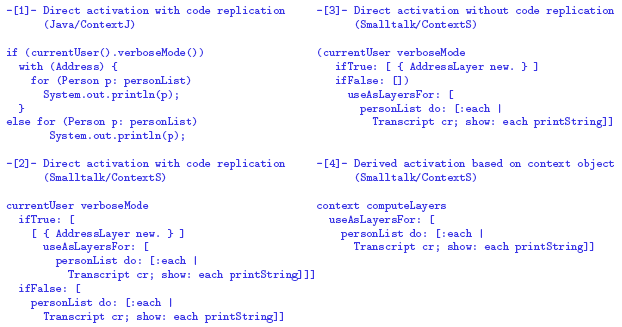
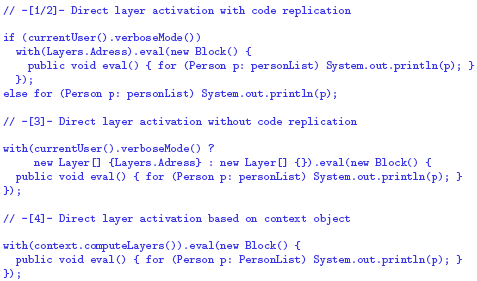
Figure 5: Direct layer activation. Contrary to the examples discussed in previous publications about our work on COP, this code example does not modularize the source code along the layers, but keeps the object-oriented modularization along classes. In other words, instead of textually grouping partial class definitions inside layers - which is similar to grouping aspects or features within their own modules in AOP and FOP - the layer definitions are textually grouped inside classes. This layer-in-class notation has different trade-offs than the class-in-layer notation. One advantage is that layers can refer to private fields of the core class definition, whereas in class-in-layer notations, members that need to be referred to in other layers (aspects, features, etc.) cannot be fully encapsulated. Another advantage is that new classes can be added to a system offering their own layer-specific behavior without the need to change layer definitions elsewhere. Our example, as discussed here, uses simple print statements to display information about objects, which in turn call the toString methods. In situations with more advanced GUI presentations required, state changes need to initiate automatic updates of such on-display presentations. In Section 5, we show how COP can be beneficial in the implementation of display update behavior. Environment-dependent Behavior VariationsIn the previous example, the composition of behavioral variations is explicitly initiated by actors using the with construct from within the control ow of the program. In the general case, however, activation or deactivation of layers may depend on non-local contextual conditions of the environment. For example, whether address information (or other kinds of information) is displayed may depend on the setting of some menu entry in the client program, on a user's login status, whether a user has sufficient access rights to view sensitive information, and so on. In general, any dynamic condition can determine whether some layer should be activated or not. The with construct is in principle already sufficient to express this: It can just be guarded by an appropriate if statement. In Figure 6, this is shown for both ContextJ and ContextS, our COP extension to Squeak/Smalltalk. The disadvantage
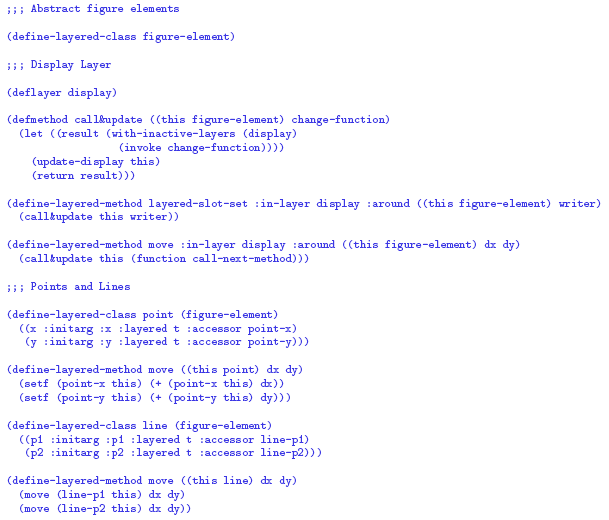
Figure 6: Conditional layer activation. in this case, though, is that the code on which layers may need to be activated or not must be duplicated for each branch (code sections 1 and 2 in Figure 6). In ContextS we implemented an alternative approach to conditional layer activation: The message useAsLayersFor: can be sent to a sequenceable collection that contains the layers to be activated when evaluating the block passed as argument to useAsLayersFor:. This property can be used to avoid code duplication in the alternative branches of a guarding clause (code section 3 in Figure 6). In principle, ContextJ can be designed to support first-class layers and computed layer activation as well (see Appendix A). The solution in ContextS is remarkable, though, in that Smalltalk lends itself to designing layers as first-class objects from the start and that especially Smalltalk's elegant block construct makes syntactic language extensions for layer activation and deactivation unnecessary. This allows us to avoid explicit conditionals in general, and to use dedicated computations that derive layer combinations appropriate for a particular execution context. With that, context can be modelled as first-class objects that, for example, can be used as shown in section 4 of Figure 6. System-dependent Behavior VariationsTo illustrate a COP-style implementation of system-dependent behavior variations, we show a modified version of the figure editor code written in ContextJ [16], here implemented in ContextL, our first fully implemented programming language extension for COP [14] built on top of the Common Lisp Object System (CLOS). The figure editor is a prominent example used in aspect-oriented software development to motivate cflow-like constructs needed to deal with the phenomenon of jumping aspects [11].
Figure 7: A layered implementation of the figure editor example. In Figure 7, we see a layered class figure-element providing a simplified abstract
interface to graphical objects to be presented on the screen. The code also
defines a layer display that handles display updating on slot changes: Whenever
a layered slot is changed through an assignment, the reflective function layered-slot-set is called on the object whose slot is to be assigned, together
with a first-class function writer that performs the actual assignment when invoked.
The function layered-slot-set is overriden for figure-element to perform the Figure 7 also contains two example classes point and line that inherit from figure-element. They define x- and y-coordinates, and two endpoints respectively, together with specifications for implicit initialization arguments for constructors :initarg and accessor methods :accessor, which are standard slot options in CLOS. ContextL adds the :layered option that indicates whether the respective slot is layered or not. This allows fine-grained control over which slots are read and written through reflective functions and allows expressing, in this example, whether a change to a specific slot should trigger an update to the screen or not. In the general case, graphical objects may be either primitive, like point, or composites, like line, which consists of two endpoints. Usually every change to a composite object, for example by calling move on a line instance, implies respective changes to the primitive objects the composite combines. However, a call of a top-level move should only cause a single notification after performing all implied changes to the combined objects to avoid unnecessary and inaccurate intermediate screen updates. To this end, both layered-slot-set and move are defined in the layer display to first deactivate display itself for the dynamic scope of the actual change of the figure element. In order to avoid code duplication, the common code for layered-slot-set and move is factored out into a higher-order function call&update that expects a parameterless function for performing the update on an object and the object itself. The around method for layered-slot-set in the layer display passes the writer parameter, and the around method for move in display passes the CLOS construct for super calls, call-next-method, as a function. It is this deactivation of the layer display in call&update that is neither triggered by an actor nor by dynamic conditions in the environment, but is internally required by the system to coordinate display updating. DiscussionWe have already introduced ContextL and a variation of ContextJ in previous publications on COP. The examples given above summarize the examples discussed before to illustrate COP as a more general concept, but also discuss new elements of the respective languages. Notably: (a) We have shown ContextJ with an AOP/FOP-style class-in-layer notation before, but this paper introduces the layer-in-class notation for the first time. (b) ContextS is used here to illustrate an elegant way to deal with layers as first-class objects. Layers as first-class objects are also available in ContextL but have not been discussed before. (c) In the ContextL example shown here, we discuss layered slots for the first time which allow for intercession of slot accesses in layered methods. These examples all show that the notion of layer activation and deactivation is a useful concept of its own, independent of how the source code is structured to define layer-specific behavior. Indeed, the essential contribution of COP is the ability to refer to layers at runtime and activate or deactivate them in arbitrary code locations. In other words, COP brings a similar degree of dynamicity to the notion of crosscutting concerns that object-oriented programming brought to ad-hoc polymorphism.
Figure 8: Layer activation from within a loop. In this regard, it is especially interesting to compare COP to cflow-style constructs from aspect-oriented programming. Cflow constructs, as introduced with AspectJ-like languages, match join points within the dynamic extent of another join point [29]. They allow for the expression of control-flow-dependent behavior variations and, in conjunction with if pointcuts, the conditional composition of such behavior variations. In this sense, AOP languages with flow constructs can already be regarded as supporting a context-oriented programming style. However, AOP has emerged from the ambition to textually modularize crosscutting concerns. In this sense, the layer-in-class notation used in the ContextJ example above would not qualify as AOP because it scatters layer-specific definitions in the classes to which they belong. Another important difference between cflow-style pointcuts in AOP and layer activation/deactivation in COP is that COP allows the use of layer activation/deactivation in arbitrary places of the source code whereas pointcuts in AOP can only trigger at join points as exposed by the rest of the program. For example, consider the ContextJ example from above and assume that we want to print a list of persons with their employers and the employers' addresses, but not addresses of the persons themselves. In a COP style, we can write this down directly (Figure 8). With cflow-style pointcuts, we would have to ensure that the relevant part of the loop body is exposed as join points, for example by factoring it out into a separate method or using statement annotations [18]. In both cases, the join points would have to be exposed, which means that encapsulation boundaries are potentially violated and that the join point interface has to be maintained for future versions of the code due to the fragile pointcut problem [31]. In the figure editor example, a reflective hook is used for intercepting slot accesses. This is modelled along the lines of, and actually in terms of, the similar slot access protocol in the CLOS Metaobject Protocol [28]. This style is a natural fit for the typical higher-order programming styles which are traditionally used in Lisp dialects to integrate crosscutting and non-functional concerns. This example is shown here to illustrate further that the notion of dynamic layer activation and deactivation is independent of other elements of programming style supported by a given language. Furthermore, the conditions for triggering updates in the figure editor example continuously change at runtime. This requires efficient implementations from both aspect-oriented-style cflow constructs as well as context-oriented-style layer activation and deactivation. We have previously shown how ContextL can be implemented efficiently [16]. In aspect-oriented approaches, both static analysis [5] and guards [10] show substantial improvements over naive checks of control flow properties. The latter implementation strategy, as used in the newest version of the Steamloom virtual machine, is a dynamic optimization and therefore especially interesting for possible future COP implementations. 6 RELATED WORKAspect-oriented and Feature-oriented Programming Aspect-oriented programming language extensions provide constructs for modularizing crosscutting concerns [30]. A crosscutting concern is some program behavior, be it functional or non-functional, that does not fit the dominant modularization of a program. For example in object-oriented languages, the dominant modularization is based on a class hierarchy where the only way to share state and behavior across several classes is by way of inheritance. An aspect can define additional state and behavior across several classes independent of the structure of the class hierarchy. An especially interesting contribution of aspect-oriented programming are means to decrease code scattering: The source code of a program exhibits code scattering when the same, or similar, fragments of code are repeated throughout. Aspects can help to reduce code scattering by abstracting away the places in a program where some code has to be executed, and defining that code only once and in a single location. Like AOP, feature-oriented programming [7] also targets crosscutting concerns. For example, the mixin layers approach [37] models features as layers which consist of partial class definitions, similar to the layers of Context-oriented Programming as described in this paper. The approach taken in [4] is based on mixin layers that may include constructs for defining AOP-style pointcuts and advice, showing that AOP and FOP are not fundamentally incompatible. However, the focus of FOP is on compile-time selection and combination of feature variations, and more recent tool support incorporates algebraic means for reasoning about such feature combinations to improve static analyzability [6]. Context-oriented Programming, as presented in this paper, is closer to FOP than to AOP: It also takes the notion of layers and provides means for selecting and combining them. However, the main difference between FOP and COP is that the former focuses on compile-time selection and combination, whereas the latter adds the notion of dynamic activation and deactivation of layers together with scoping mechanisms to delimit their activity state. Unlike AOP and FOP, COP does not require the textual modularization of crosscutting concerns in the source code of a program. As illustrated in Section 5, the behavioral variations may be placed in the source code by making them part of the respective class definitions. However, it must be possible to unambiguously refer to all the behavioral variations that belong to one layer. Otherwise, dynamic activation/deactivation of behavioral variations would not be feasible in a straightforward way. It is exactly this possibility to refer to crosscutting behavioral variations grouped as layers at runtime that is important for Context-oriented Programming. Context-awareness The term Context-oriented Programming was first used to refer to the notion of context-aware applications in pervasive and ubiquitous computing. Early approaches focused on the modeling and provision of context information [17]. While this is an important prerequisite for implementing context-aware applications, Context-oriented Programming is concerned with programming language constructs to represent and manipulate behavioral variations. The first precursors to the generalized notion of Context-oriented Programming presented in this paper were placed in the context of pervasive and ubiquitous computing [20, 27]. Dynamic Activation Programming languages that treat procedures or methods as first-class values allow programs to be structured in a way that they can exhibit different behavior under different circumstances. In pure functional programming languages like Haskell, they can be passed as parameters to higher-order functions, and in languages like Scheme or ML, they can be assigned to variables which can be side-effected later on to change the behavior of a program. However, the availability of first-class procedures alone does not offer sufficient means to coordinate changes of several collaborating procedures. First-class environments offer a way to group several variable bindings, which can contain first-class procedures or functions as values, and allow code to be executed in such environments or even manipulate their bindings. However, aside from some implementations of Scheme and Lisp, essentially no mainstream programming language provides first-class environments as a mechanism available to programmers. Piccola [1] is an experimental language for specifying applications as compositions of software components. A key feature of Piccola is the form - a first-class environment which is used to model, amongst others, objects, components, modules and dynamic contexts [2]. Although environments can be manipulated in Piccola, expressions are statically bound to the environment they are evaluated in, so dynamic activation of scopes is not directly supported. Scoped Activation Dynamic scoping can be used to change the binding of variables for the current execution context [22, 32, 39]. In languages with first-class functions, the change of function bindings can also be dynamically scoped, but special care has to be taken when diferent functional values for the same dynamically scoped variable need to wrap each other [13]. Dynamically scoped functions, however, still have the limitation that they do not offer explicit means to coordinate the change of collaborating functions. An interesting application of scoped activation of functions is described by Gabriel [19]. Local virtual functions, implemented as a pre-processor for C++, provide a similar concept [23]. Several aspect-oriented approaches already provide scoped aspect activation as abstractions [9, 24, 35, 40, 43], but these abstractions have foremostly been designed for aspect deployment. They are all suitable for Context-oriented Programming to different extents. Recently, ContextL [16] and Steamloom [10] have shown that scoped aspect/layer activation can be erfficiently implemented, an important prerequisite for wider adoption. This paper shows that scoped layer activation is a language construct that is independent from the textual organization of source code, be it into aspect-oriented modules, feature-oriented layers or otherwise. Other Related Work Context-oriented Programming combines layers, dynamic
activation based on context, and scoped activation. Different combinations of these
notions already exist, some of which are even quite old. The separation of programs
into layers is an idea that goes back at least to early experiments made in
Smalltalk [8, 21]. There, layers were conceived as a mechanism to express different
design alternatives of the same software, and allow the developer to try
different combinations thereof. Us [38], Delegation layers [34] and Slate [36] are
very close to COP in that they are based on layers, allow sending messages in
the scope of a specific layer, and even allow manual dynamic composition of layers.
The context-oriented approaches presented in this paper abstract away from
the need to explicitly compose layers and provide dedicated language constructs instead - with-active-layers and with-inactive-layers in ContextL, with and Changeboxes [33, 44] offer a further evolution of the notion of Classboxes. A Changebox encapsulates a software change at a higher-level of abstraction than Classboxes (which only record additions, deletions or modifications to methods). Changeboxes can be composed to provide a runtime environment for software applications. Different Changeboxes can be in effect at the same time within a running application, and may be dynamically activated or deactivated, thus supporting a form of COP. In the present prototype, activation is specified programmatically, but implicit activation based on context is planned in the longer term. 7 OUTLOOKReal software systems change over time, and must adapt to changing requirements even while they are running. Unfortunately, mainstream programming languages and development environments do not support this kind of dynamic change very well, leading developers to implement complex designs that anticipate various dimensions of variability. We propose instead to develop a notion of Context-oriented Programming that directly supports variability depending on a large range of dynamic attributes. In effect, runtime behavior can be dispatched on any properties of the execution context. Our first prototypes have illustrated how COP supports multi-dimensional dispatch to achieve expressive runtime variation in behavior. More research and experimentation is clearly needed into different ways to compose and trigger variations. For example, variations may be expressed not only as differences in code, but as extensions, wrappers, advice, refactorings, or general transformations. Variations may not only be triggered explicitly and programmatically, but also implicitly by means of rules or constraints. One compelling application domain for COP is to control software evolution. COP can enable runtime deployment of software changes while strictly delimiting the visibility of changes to specific clients and leaving others untouched. Radical changes can slowly percolate through a running system, without breaking clients which are not ready for them. Backwards-compatibility need no longer be a critical concern if the client context is taken into account when deploying changes. Global consistency is neither assumed nor desirable. COP signals a move away from application-specific solutions to runtime variability (such as those offered by many design patterns), and instead focuses on developing a new programming paradigm and corresponding language constructs and underlying software infrastructure to support context-dependent behavior. We believe that these steps are essential to achieving the high degree of maintainability, robustness and adaptability that is needed for the emerging breed of dynamic, mobile and pervasive applications. Implementations of ContextJ A CONTEXTJ
|




 , ContextS, and ContextL can be downloaded from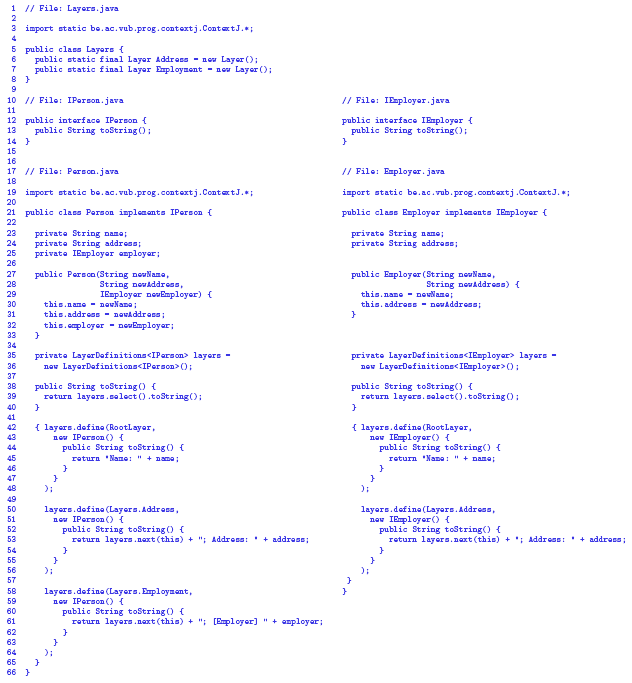
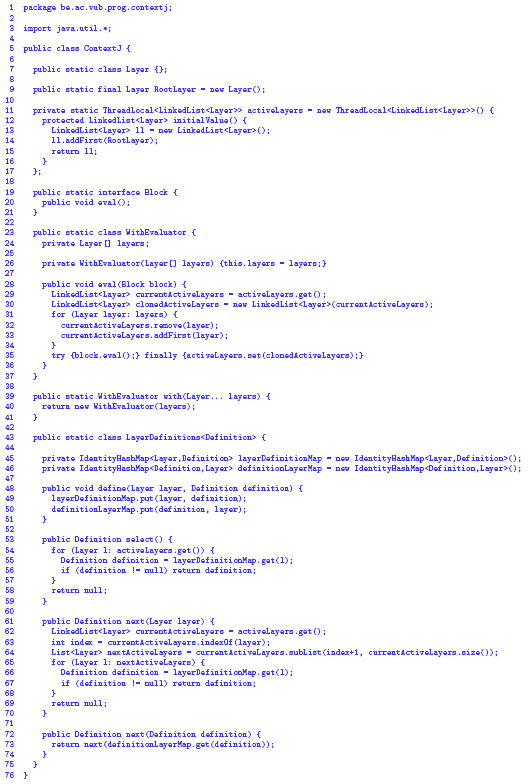
 |
Robert Hirschfeld is a Professor of Computer Science at the Hasso-Plattner-Institut (HPI) at the University of Potsdam. He received a Ph.D. in Computer Science form the Technical University of Ilmenau, Germany. He can be reached at hirschfeld@hpi.unipotsdam.de. See also http://www.swa.hpi.uni-potsdam.de/. |
|
 |
Pascal Costanza has a Ph.D. degree from the University of Bonn,
Germany, and works as a research assistant at the Programming
Technology Lab (Prog) of the Vrije Universiteit Brussel, Belgium.
He can be reached at pascal.costanza@vub.ac.be. See also http://pcos.net. |
|
 |
Oscar Nierstrasz is a Professor of Computer Science at the Institute
of Computer Science (IAM) of the University of Bern. He
completed his B.Math at the University of Waterloo in 1979 and
his M.Sc. in 1981 and his Ph.D. in 1984 at the University of
Toronto. He can be reached at oscar.nierstrasz@acm.org. See also
http://www.iam.unibe.ch/~oscar. |
Cite this article as follows: Robert Hirschfeld, Pascal Costanza, Oscar Nierstrasz: "Context-oriented Programming", in Journal of Object Technology, vol. 7, no. 3, March-April 2008, pp. 125-151, http://www.jot.fm/issues/issue_2008_03/article4/.